The midnight communion service has been my favourite one of the year since I was in my teens. There is just something I find magical about heading over to church in the dark and hush of the late evening, the dim light inside the church adding to the intimate hush as we wait for the service to begin. My first mince pie of the season when I get home.
I married into a Polish family, and that means that for us, as for most Europeans, the afternoon on Christmas Eve is when the Celebrations really begin. The tree, which has patiently been sitting nude in the corner of our living room, will finally be decked out. The things we use to decorate the house in Advent come down and our Christmas decorations go up and as evening falls ‘when you can see the first star in the sky’ the vigil meal begins. That’s a bit of an epic in itself and traditionally has 12 courses, each of which in turn seems to drop a little more overtly the conceit that we are, as my mother in law puts it ‘technically fasting’.1 This has only added to the magic of Christmas night that I knew growing up.
In between the end of the meal and the midnight service we exchange a small gift, and offer our good wishes to one another for the year ahead while eating the opłatek (pronounced ‘op-wa-tek), a time when I have always felt even more socially awkward than is usual for a stereotypical Englishman, and very grateful for my English Father in Law, who I know is feeling just the same as I am.2
Then we sing carols – especially ones which focus on the visit of the angels to the shepherds – some in English and others in Polish or occasionally German (90% of my Polish vocabulary is Christmas Carol terms). I have a fascination I can’t quite describe with the mystery of one of the most significant events in history happening in seeming obscurity and several of our carols convey that well:
The hopes and fears of all the years are met in thee tonight
A thrill of hope, the weary world rejoices, for yonder breaks a new and glorious dawn
To show God’s love aright, she bore to men a Saviour when half spent was the night
To go along with this, Common Worship has given us a collect which I think is a real winner. For me at least, it perfectly captures the thrill of the night time revelation of Christ.
Eternal God,
who made this most holy night
to shine with the brightness of your one true light:
bring us, who have known the revelation of that light on earth,
to see the radiance of your heavenly glory;
through Jesus Christ your Son our Lord,
who is alive and reigns with you,
in the unity of the Holy Spirit,
one God, now and for ever.
Below (in what feels like a more jarring transition than I’d planned now I write it) is a sermon I recently gave on the visit of the angels to the shepherds for a carol service at church.
It was late in the day on the 7th of May 1945 when a BBC newsflash interrupted their scheduled programming to announce that Nazi Germany had unconditionally surrendered to the Allied forces. The war in Europe was over. We’d won. The next day, the 8th, was to be the first ever VE Day. It was greeted by wild celebrations, not only in Britain, but around the world, in Australia, in New Zealand, in America and in the Soviet Union. Winston Churchill called the ministry of food early in the morning to check there would be enough beer in London to handle the celebrations. The Board of Trade announced that you could buy red, white and blue bunting without using ration coupons. People praised God in services across the country, there were street parties everywhere, pubs stayed open late, there were bonfires, and fireworks and 50,000 people at Piccadilly Circus. Next year will be the 80th VE day celebration, because we still remember that day. The world had changed, and it had changed for the better.
The night that Jesus was born, the angel explained to the shepherds what had happened using a word we translate as ‘good news’. But it’s not a word you’d use for everyday good news. It means good news on a scale like VE day. Good news of something that has changed the world for the better. Which is why hundreds, maybe thousands of angels pour out of heaven to celebrate and praise God. You can read the Bible cover to cover and scour the history books, but nothing like that has ever happened before or since.
Christmas is about world changing good news. Actually, the whole of Christianity is about world changing good news. Sometimes that can be easy to forget, not least because the Church can make it difficult to remember, but when you come back to the beginning that’s what it was all about that first Christmas night. The angels didn’t announce a new set of rules or a moral code. They didn’t announce a new ritual or even a new festival. Christianity has those things, but it’s not about those things. At its heart, Christianity is about good news on a scale that will change the world.
And the angels are keen to underline that it’s good news for all the people. It was a message of joy for the shepherds, who would have been relatively poor, uneducated, low status people from just down the road. It was also a message of joy to the wise men, wealthy scholars from hundreds of miles away, who didn’t even practice the same religion as the Jews. Christmas is about good news for everyone. That means it’s good news for you. Whoever you are, whatever your background, whatever your past, Christmas is good news of great joy for you if you believe it and take it to heart.
But what is this news? It’s that a saviour has been born. I know that saviour is a word we hardly use outside religious contexts. Here it means someone who can bring us back to God. The Queen put it brilliantly in her Christmas speech back in 2011:
“Although we are capable of great acts of kindness, history teaches us that we sometimes need saving from ourselves – from our recklessness or our greed. God sent into the world a unique person – neither a philosopher nor a general (important though they are) – but a Saviour, with the power to forgive.”
We need someone who can fix the relationship between heaven and earth. You see that on Christmas night because the shepherds are terrified. That’s not just because of the shock – one minute you’re washing your socks by night, the next there’s dazzling light everywhere. Terror is the usual reaction to seeing an angel in the Bible. Because deep down people sense that all is not well between heaven and earth. The world and our individual lives contain too much that is wrong for us to sit comfortably with a God of perfect justice. I don’t know what you think of God but the Bible paints a picture of us living in deep alienation from him. That can look different to different people. Some openly reject him and ignore him, but some slave away, hopelessly trying to earn his approval, and others sprinkle a bit of religion into their lives to try to pay him off so he’ll leave them alone. Some run and hide from him, and others cluelessly presume that all is well. The angel is saying that Jesus came to fix that. His birth is the start of God’s work to reconcile people with him, to mend our relationship with him and make us his beloved children.
But it’s not just individuals Jesus has come for. The angel calls him Christ, the Lord. The Christ (or Messiah) is an idea with a rich array of meanings in Scripture, but at the heart of them is God’s promise of a King who will rule the world forever, bringing peace and justice, freedom and joy to the whole planet. Jesus came to save individuals, but also to fix the whole world. Jesus was born into a world of exploitative, cash hungry empires like the Romans, of violent, oppressive rulers like Herod, and the kind of poverty and want that would lead you to put a newborn baby in a manger because you don’t even have a cot. He knows what the real world is like. But he’s bringing an end to all of that. I don’t want to get ahead of myself – just wait until Easter – but even death’s days are numbered now Jesus has been born.
What are we supposed to do about this? Well there were two responses that first Christmas night. The Angels are already on board with the good news of Jesus. So they celebrate – they give glory to God in the highest and proclaim peace to his people on earth. If you’re a believer in Jesus, celebrate Christmas with all the gusto you can manage. Praise God, spread the word – good news is in short supply these days – and take time to wonder anew at the saviour’s birth.
But that might not be you. Perhaps you’ve got questions. Maybe you’re not someone who believes in angels and Messiahs. I respect that – I come from an agnostic background myself. But can I encourage you to do what the shepherds do when they hear the news? They say ‘let’s go and see’. Come back, ask your questions, find out more, give it a look. We’ve got more Christmas services coming up this week – or you could take some time to reflect on it during the Christmas break and come back in the New Year.
Jesus’ birth is news so good heaven itself couldn’t contain its joy that first Christmas night. Christians have been celebrating ever since. The world has changed, and it’s changed for the better. So I wish you all a very merry Christmas and a Happy New Year 2025.
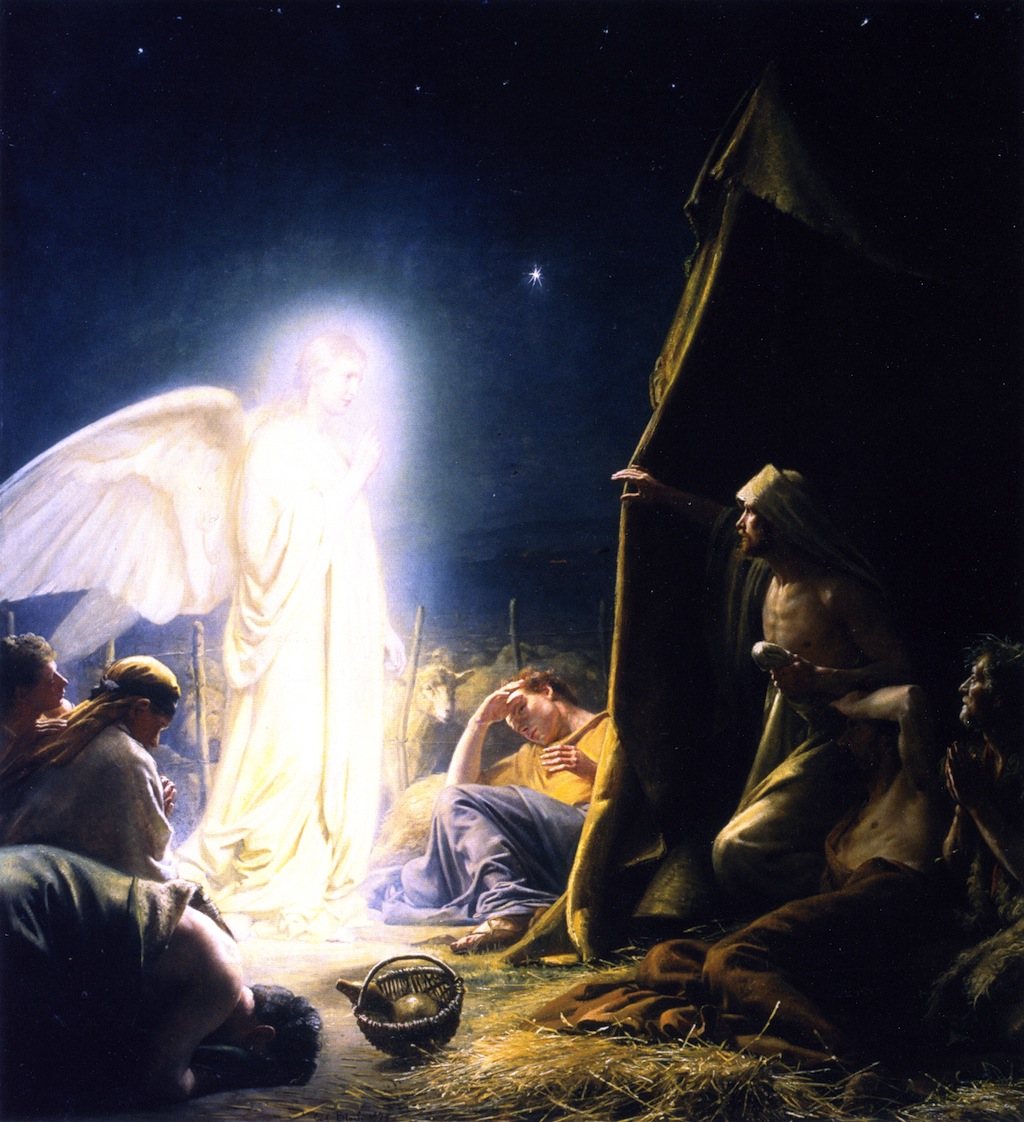
The post image is Carl Bloch’s The Shepherds and the Angel.

 Christ and Calendar