And you thought the party was over.1 January is not a time of year known for the festive spirit. The children are going back to school this week. The Christmas jumpers are back in the cupboard, the decorations are coming down and the two great penitential seasons of the secular calendar, Veganuary and Dry January, are both underway. For most people, January is a time for abstemious resolutions and working off the excess mince pies. Cold weather, cold turkey and Couch to 5k.
But not in the Church calendar! The spiritual barometer is set ‘festive’ for the whole month of January, all the way up to the Feast of the Presentation of Christ on 2nd February. Welcome to the season of Epiphany.
The name Epiphany comes from a word that means ‘manifestation’, hence the Prayer Book gives this festival an alternative name ‘The Manifestation of Christ to the Gentiles’. That sets the tone for the whole season: Christmas celebrates Jesus’ birth among us, the Word become flesh. Epiphany celebrates the ways his glory is manifested to the whole world. The calendar helps us in doing that by drawing us to consider certain moments in the life of Jesus where we catch a particular glimpse of his glory.
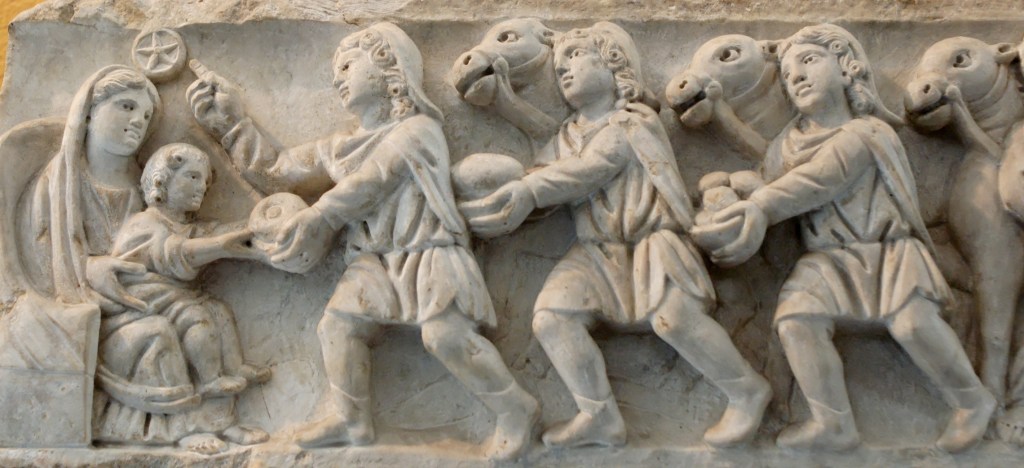
Today, 6th January, we consider the event most strongly associated with Epiphany in the West: the adoration of the magi.2 This moment, recreated countless times in the history of art, is a window into Jesus’ glory and a snapshot of the world to come.
The joy of Jesus at Epiphany
In Matthew’s account, we are told that the Magi are overjoyed when they see the star and realise that their journey is almost over (Matthew 2:10). The NIV rather blandly translates this as ‘they were overjoyed’, but the ESV sticks closer to the way Matthew piles up expressions of joy in the Greek with ‘they rejoiced exceedingly with great joy’. I can’t help imagining laughter and tears of gladness rolling down their cheeks.
When they arrived at the house, they saw what they had travelled so far to encounter: ‘the child’ (2:11), ‘the one who has been born King of the Jews’ (2:2), even ‘Immanuel, which means “God with us”’ (1:23). They see him with his mother, Mary, the pure virgin who gave birth to God, the mortal woman on whom the divine toddler was still utterly dependant.3
As they contemplate these things, they drop to the floor, prostrating themselves in awe and reverence and worship the little child before them. The word Matthew uses for ‘worship’ can simply mean the kind of homage you pay to a King, but as Matthew keeps using the word throughout his Gospel, it becomes ever clearer that we are meant to see the worship of the incarnate God. Then, as is doubtless familiar to us, they open their treasures and offer him gifts.
It’s a scene that, even on a first reading, is charged with joy, wonder, and mystery. But it is also, as I said, a glimpse into a world to come. To see how, consider four things about the Magi themselves.
Firstly, the magi are foreigners. It’s impossible to be sure exactly where they came from, but the most likely places are either Babylon (in modern day Iraq) or, further east, Persia (modern day Iran). Either way, they come from far away. They have travelled hundreds of miles to get to Jerusalem. Though they seek the King of the Jews, they are not themselves Jewish. Rather, they foreshadow the great commission at the end of Matthew, when the apostles were sent out to preach the Gospel to every nation. And they are a glimpse of a time when all nations come to the light of Jesus. Isaiah 60, which is read alongside Matthew 2 at Epiphany, prophesies the day when the nations stream to Jerusalem in search of the light which has dawned upon Zion, the glory of the Lord.
Already this is a thing worth celebrating. Even if we only look at it from a self-interested standpoint, I am a Gentile, and I suspect most of my readers are too. It is healthy to be reminded that from a Biblical perspective, we too are foreigners drawn into the Lord’s people. Christ, the King of the Jews, was born for us also. But much more than mere petty self-interest, this moment points to a world made joyful in Jesus, a world in which every culture has Jesus as its radiant centre, where every language resounds with his worship and every nation can joyfully say ‘God is with us.’ It points to a joy and a splendour which I struggle to imagine.
Secondly, the magi are – as many traditional translations put it – wise men. The Magi were a caste of people associated with learning. In Matthew it is evident that they studied astronomy. Indeed, other sources show us that the ancient Babylonians and Persians had a remarkably detailed and sophisticated grasp of the movements of the stars and planets, such as they could be known before the invention of the telescope. But they were also known for their study of philosophy, their desire to penetrate to a deeper understanding of the world, riddling out the meaning of things. They studied Babylonian literature and history. Magi served as courtiers and counsellors to mighty kings and emperors. In short, they were scholars, devoted to finding a unified way of explaining the world and human experience.4 Here we see a glimpse of a world where the learned bow down and worship Jesus.
We often emphasise simplicity at Christmas and that’s absolutely right. Several things indicate that the holy family were poor. The blessed Virgin Mary rejoices in God bringing down the mighty from their thrones and exalting those of humble estate. Jesus first courtiers were humble shepherds. The whole logic of the incarnation is that of the Son taking the form of a servant and making himself nothing (Phil 2) that he who was rich became poor for our sakes (2 Cor 8:9). But Epiphany adds to this valorisation of the humble, the downtrodden and the simple, a glimpse of a time when every branch of human learning finds its completion in the worship of Jesus. Every art and every science finds its true meaning in relation to him. Every skill and every invention will be used to display his glory. If there is a University of the New Jerusalem every course structure there makes transparent the centrality of Christ and its scholars find their thirst for knowledge quenched again and again as they come to know him better. Each new question and each new discovery will only make us love him more.
In connection with their status, the magi are, thirdly, wealthy men. They don’t merely open their luggage in verse 11, they open their treasures. Of course, we all know what they gave, gold, frankincense and myrrh. Many commentaries point out – some more sardonically than others – that the holy family could have had precious little use for these things beyond what they could have got by selling them. That isn’t the point, however. These are the sorts of treasures you bring to honouring a King. Indeed, another look at Isaiah 60 reminds us that Kings will come to the brightness of Zion’s dawn (60:3), that gold and incense will be among the gifts (60:6) as the wealth of the nations streams in, ‘their Kings led in triumphal procession’.5
In this way – and read against this Scriptural background – the adoration of the magi gives us a glimpse of a time when all honours are paid to Jesus and when all that is best and most precious in the world is gladly brought to him as tribute. All the beauty and sumptuary of Christian art throughout the ages – and it is considerable – will be but a faint flicker of the splendour of the glory that will surround our King in eternity.
But fourthly and most surprisingly, the magi are astrologers. Indeed, magi is the etymological root of our word ‘magicians’ and in every other instance of the word in the New Testament (or its Hebrew equivalent in Daniel) the ESV translates it as ‘magicians’. The magi were originally priests in the Zoroastrian religion and were known for their interest in charms, divination and collecting prophetic utterances. They studied the stars because they believed that they were able to give omens and portents and to control human destiny. That is why a new star – whatever precisely the star of Bethlehem may have been – leads them to conclude that a King has been born among the Jews.
God strictly forbids astrology throughout Scripture as an idolatrous practice – a way of worshipping the creature rather than the creator. Every other reference to magi in the Bible is negative (see Dan 1:20, 2:2, 10, 27, 4:7, 5:7, 11, 15, Acts 13:6, 8). So it is astonishing that, on this occasion, their magic arts lead them to Jesus. Not all the way, you will notice – they needed the Scriptures to tell them that Bethlehem was their final destination6, and when they get there, they worship, not the stars, but the child Jesus. How can we understand this? Certainly, Matthew does not intend this as an endorsement of astrology or any of the other esoteric arts which are today, if anything, becoming more mainstream. Nor is this a parable about how all religions lead to God in the end – that is simply to cherry-pick one positive story about magi and pit it against the uniform condemnation of magic in both Old and New Testaments.
Instead, I think it is better to say that they show us the true meaning of the stars. They are not omens – at least not in the sense the magi would have assumed – but neither are they simply the exploding balls of gas that modern astronomers assume. Rather, in contradistinction to both pagan astrology and secular astronomy, the stars speak eloquently of the glory of God (think e.g. Psalm 19). That a star leads, on this occasion, to consulting the Scriptures and so worshipping Jesus, is a sign that all of nature is meant to lead us to him. We know nothing of the subsequent careers of the magi, but it is notable that the route of their return journey is determined not by their magic arts, but by a divine revelation (Matt 2:12) Is it too much to hope that when they arrive back amongst the Babylonians and Persians their wisdom will look rather more like the visionary Daniel, who studied the Scriptures, saw the future and was given the ability to understand dreams and riddles?
So in this scene we get a glimpse of a world where literally everything, the stars and planets themselves, revolve around Jesus. A world where all nature is transparent to his glory. A world where nature will be free of humanity’s idolatrous desire to worship it or the sorcerous desire to wield it to unnatural ends. A world where the earth will be filled with the knowledge of the glory of the Lord as the waters cover the sea.
The Challenge of Jesus at Epiphany
What should we do, having reflected on this scene and the mystery of the world to come that it discloses?
We are meant, surely, to imitate the magi in joyfully bowing down before Jesus. Foreigners included in his people should rejoice that his glory has shone in our darkness and Jews who have come to know him should rejoice at the nations coming to the God of Israel. To the extent that we have any learning, we should make all of our thoughts and studies sing his praise. We should find ways to bring him even into our hobbies and skills. We must gladly give him the best and most precious things in our lives. And we should turn away from idolatrous ways that value other things over him. And in all this we should look forward, rejoicing with exceeding great joy, to the day when the whole universe freely, willingly, gladly does this.
These things are easy, indeed, pleasurable, to type. But we often find them desperately difficult. Sometimes our sacrifices are made more grudgingly than cheerfully. Disobedience frequently sullies the homage we pay. If we are truthful, we often find ourselves responding with the fear and hostility of Herod, the consternation of Jerusalem, or else the cold indifference of the scribes, who read of Jesus in the Scriptures, but did not take a few miles journey to pay their own homage. How do we find the joy of the magi in our own lives?
The key – and I make no pretensions to having mastered this – is to appreciate the glory of Jesus. Don’t look at the magi except to look at what they saw, the divine child with his mother. The whole season of epiphany is about beholding the glory of God in the face of Jesus Christ. As we do that, we see that it is right, good and beautiful to place Jesus at the centre. Just as the moons and planets of the solar system would be thrown into darkness, chaos and disorder were it not for the Sun at the centre holding all in harmony, so creation and all that we love finds its rightful place, and its fitting beauty when Jesus is placed at the centre. Everything we may sacrifice is purified and perfected when it rightly displays Jesus’ glory and leads us to him. In giving ourselves and all that is precious to him we are, in fact, receiving him as the gift beyond all telling, the pearl of great price.
The collect for today is short and simple. It draws together the twin themes of the season – the manifestation of Christ to the Gentiles and the glory of God. As we reflect on the adoration of the magi we get, by faith and at second hand, a glimpse of Jesus’ glory. But it should our hearts with the hope of enjoying that glory forever in the world to come. So it is for this we pray:
O God, who by the leading of a star didst manifest thy only-begotten Son to the Gentiles: Mercifully grant, that we, which know thee now by faith, may after this life have the fruition of thy glorious Godhead; through Jesus Christ our Lord. Amen.
May we, this Epiphany season, find the joy of the magi in worshipping our glorious King.
The image is from a 4th century sarcophagus which is in the Vatican. It was photographed by Jastrow in 2006.
- This post expands and replaces the original Christ and Calendar post for the Epiphany. ↩︎
- In the East, as in much of the early Church, Epiphany is more strongly associated with Jesus’ baptism or the wedding at Cana, both of which are also themes in a Western Epiphany season. ↩︎
- We shouldn’t let a suspicion of the excesses of some Marian piety to blind us to the reverence Scripture shows towards Mary, or the awe-inspiring mystery of her role as the Mother of God. Note that throughout Matthew 2 ‘the child and his mother’ is repeated five times and when Joseph appears at all (he is invisible in this particular scene) his sole concern is to protect ‘the child and his mother’. ↩︎
- This is a bit of a simplification. As we will see, Magi are generally portrayed negatively in the Bible. Depending on what ancient sources you look at, they are sometimes portrayed as experts in wisdom, lore and the magic arts, fit to serve as counsellors to Kings (think of the Wizard Gandalf, or Merlin), some sources view them as malevolent sorcerers practising the dark arts (think of Grima Wormtongue) and others simply as frauds, (conjurors of cheap tricks). Presumably, given the variety of characters in academia today, there were individual magi who justified each stereotype. Despite Scripture usually taking the latter two views of magi, Matthew clearly wants us to think well of these ones, so I think it is justified to look at them, if not in the light of their achievements, then at least in the light of their best aspirations. ↩︎
- Warning: Spicy footnote follows! In connection with this, Christmas can sometimes be a high point in the year for a kind of ‘well, actually’ pedantry about the traditional nativity story. You know the sort of thing. In this case ‘well, actually, it says they were magi, not kings and we’re not told there were three of them, only that they gave three gifts’. Fine. But the image of the Kings is drawn from following a link to Isaiah 60 that Matthew intends us to pick up on. The magi are a partial fulfilment, a foretaste, of the day when the kings of the nations pay their homage. Here – as in several other places in the traditional nativity story – it is less a question of imagination riding roughshod over the historical realities in the text, so much as allowing the text and its Scriptural allusions to shape how we imagine the events. “What actually happened” encompasses both the historical event as a secular critic might reconstruct it and also its meaning in the redemptive economy. To that extent, the traditional story may – actually – represent a more careful listening to the text than one which is bound to the rules which govern the historical-critical imagination. I find the precise number of magi a subject of perfect indifference. ↩︎
- Several Evangelical commentators, perhaps worried by the role astrology plays in this story, suggest that the Magi may have encountered Scriptural prophecies through their contact with the Jewish communities in Babylon or Persia. This would lessen the shock of the Scriptural stargazers and it is true that the Magi interested themselves in such things, but I can’t find anything in the text to suggest that these Magi had any knowledge of the Scriptures. They certainly weren’t aware of the passage from Micah that the Scribes share with them. ↩︎

 Christ and Calendar