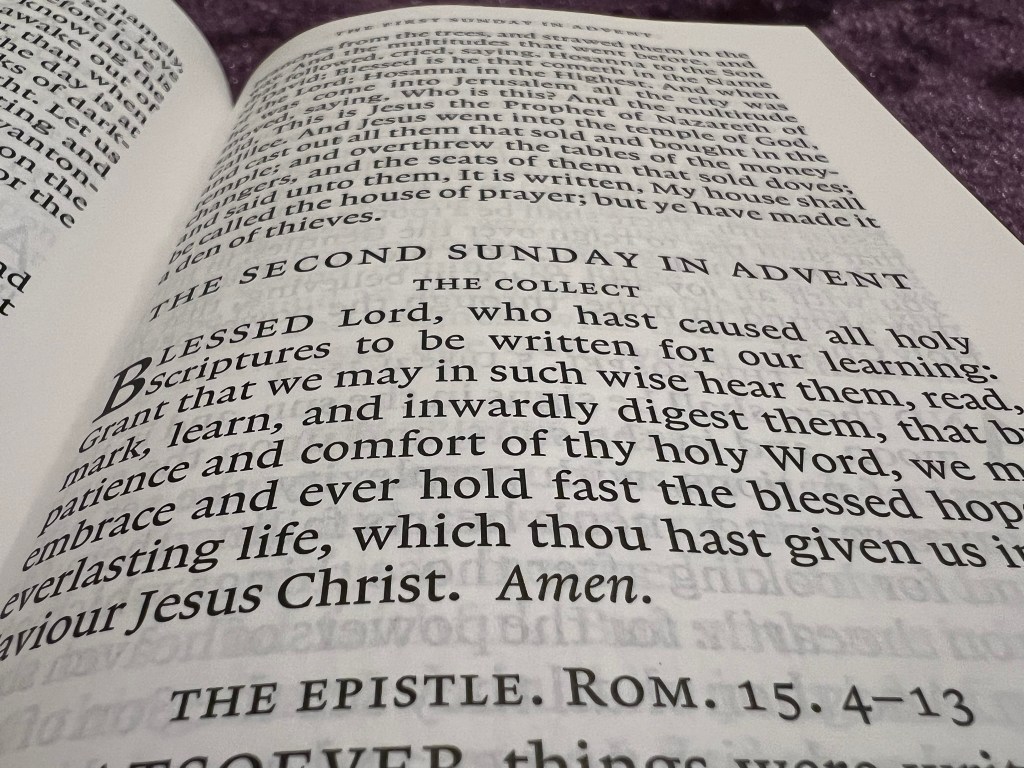
If you come from the sorts of churches I’ve spent most of my adult life in, this is the one collect you definitely know and like:
Blessed Lord, who hast caused all holy Scriptures to be written for our learning: Grant that we may in such wise hear them, read, mark, learn, and inwardly digest them, that by patience and comfort of thy holy Word, we may embrace and ever hold fast the blessed hope of everlasting life, which thou hast given us in our Saviour Jesus Christ. Amen.
Evangelicals love this collect’s focus on Scripture. There’s something about that phrase ‘read, mark, learn, and inwardly digest’ that trips off the tongue and paints a series of pictures of the kind of Scripture study we aspire to. One church I used to attend even called its small groups ‘Read Mark Learn’, an allusion to this collect combined with a pun on the fact that Mark’s gospel is the first thing you study together there.
This collect is well loved, but you might not immediately associate it with Advent. That’s partly because in Common Worship, the new liturgies introduced in the first decade of the 21st Century, this collect is moved out of Advent and put on a special ‘Bible Sunday’, which is the last of the ‘Sundays after Trinity’ (though as one of the wardens at another church I once attended once said, in evangelical churches ‘every Sunday is Bible Sunday’.) I wonder whether just in general the first half of the collect has stuck more in the memory than the second.
In its original Advent context (Thomas Cranmer wrote this collect specially for Advent II), this collect reminds us of the role that Scripture plays in preparing us for the return of Christ. As with the previous week, the collect quotes pretty heavily from the allocated readings, especially Romans 15:4-13.
Here the accent is on the role that Scripture plays in giving us hope. Paul teaches that one of the purposes for the Scripture being written in the first place was to give us hope. As his prayers in this passage show, it is ultimately the God of hope who causes us to overflow with hope through his Spirit, but it is principally through the encouragement of the Scriptures that he does that.
It’s possible for some of us that might come as a challenge to how we view the Bible. Lots of Christians think of the Bible as being basically a theology textbook – something with authority to tell you what to believe. Others treat it basically as a rule book – something to tell you how to live. And there’s important truth behind both those approaches. The Bible does tell you what to believe and how to live. It is a book about faith, it is a book about love, but it’s also a book about hope.
I’m sure you don’t need me to tell you that hope is at a premium right now in the world. 2022 has been a rough year, globally, politically, economically – on top of the every day personal tragedies that don’t make the headlines. Hope is not an indulgent thing to think about at the moment, it is an urgent need for us, for our communities and for our world.
Scripture gives hope because its hopeful message – a vision of a future world where the Gentiles join Israel in praising God through the Messiah – is woven throughout the whole. Paul’s selection of texts from the Law, Prophets and Writings in Rom 15 is designed to emphasise the point. From God’s promise in Genesis that in Abraham, all the families of the earth will be blessed, through to Revelation’s vision of a crowd from every tribe and language and people and nation, hope permeates the whole of the Bible.
I’m struck by the collect’s language of ‘holding fast’ to the hope God has given us. Possibly an echo of Colossians 1:23, it’s a reminder that false hopes and false grounds for hope are a constant temptation for the church and for individual Christians. The plans and desires of our own hearts do not automatically align with what God has promised in Scripture. We are constantly settling for less, especially lesser goods we can have now instead of greater goods we look forward to in the future. We need Scripture to continually call us back to ‘our blessed hope’ – eternal life sharing in the joy of our blessed Lord*
I also love Paul’s language in Romans of overflowing with hope. Of course, Christians are not called to live life with a perpetual cheesy grin, as though nothing ever hurts us. Hope is tough enough to look suffering in the eye, admit it is real, and, amidst the weeping, still look forward to the hope of Christ’s coming. But Paul’s language of ‘overflowing’ shows that he wants us to have so much hope that we make others around us hopeful. Joyful Gospel hope for the world should be something that so characterises our day to day lives that it rubs off on other people. In a world desperate for hope, what could be more precious than a community built on hope, empowered by the God of hope to overflow with hope to those around them?
And so, this Advent, perhaps there is nothing more urgent for us and for the world than that we read, mark, learn and inwardly digest the Scriptures.
*For a helpful intro to the doctrine of divine blessedness, the ever-worth-your-time Fred Sanders has written here.)

 Christ and Calendar