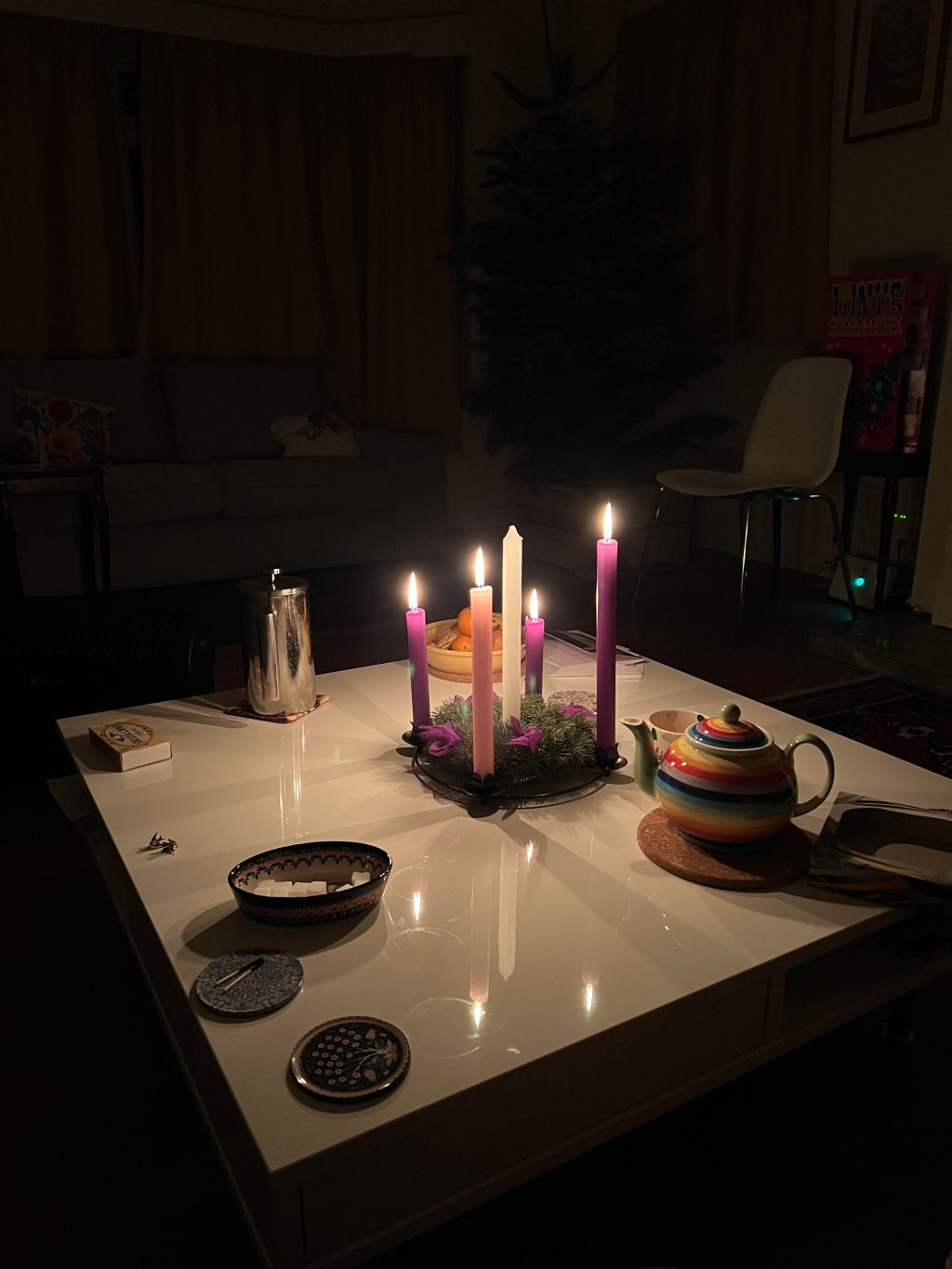
I’m sure you’ll have noticed that as I’ve talked about Advent, I’ve heavily emphasised the focus on the return of Christ. I’ve done that on purpose, partly because that’s the traditional emphasis of the season and partly because preparation for Christmas is something which most of us are already familiar with. Today I want to write about one of the traditions I observe which helps me hold the two together: the Advent wreath.
By comparison with many of the other things I’ve written about, Advent wreaths are a relatively new tradition, dating back to 19th century Germany. In their present form, they consist of five candles, four of them set in a ring with another at the centre. The colours vary a little bit, with the ring candles either being red or, more commonly, purple (the traditional colour for Advent) with one pink candle. The central candle is almost always white.
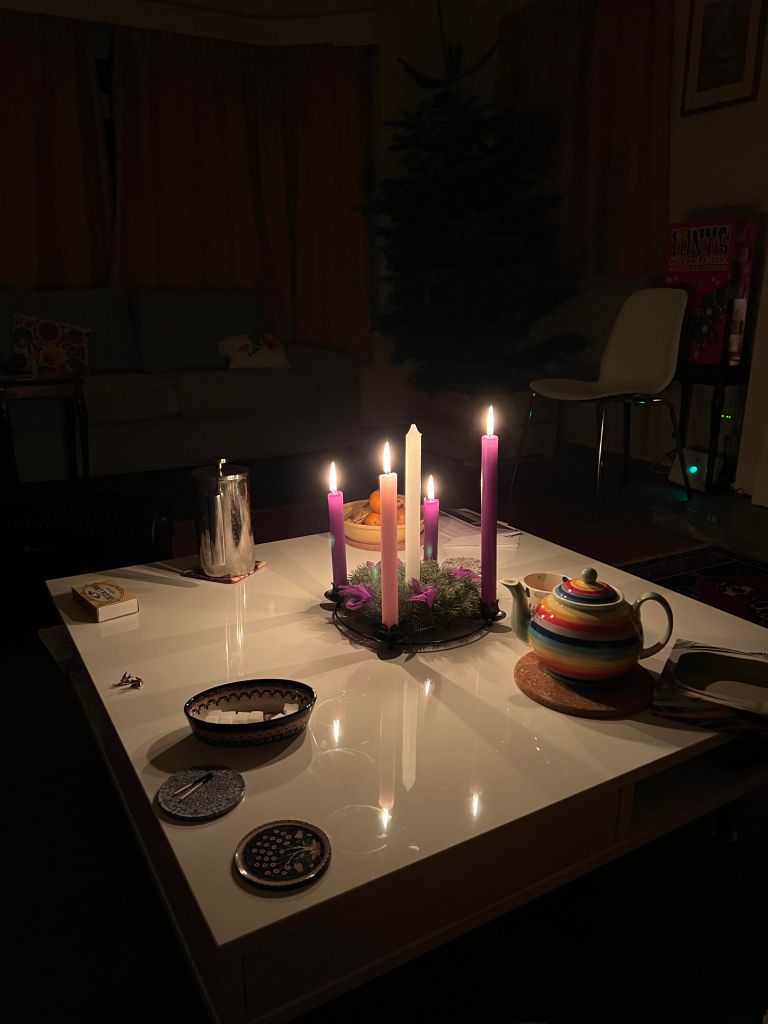
Each of the candles on the ring corresponds to a Sunday in Advent, with the central candle corresponding to Christmas. But beyond that, the precise symbolism behind each candle varies, and there isn’t yet a settled scheme. I use one of the more common arrangements, where each candle commemorates people who were instrumental in preparing for Jesus’ first coming – Abraham and the Patriarchs in week 1, the Prophets in week 2, John the Baptist in week 3 and the Blessed Virgin Mary in week 4. The Church of England has produced prayers for lighting the candles, which you can find here. We tend to use option 1, but if I’m honest, I’m never quite sure if I like them – you can use whatever reflection seems good to you.
The Advent wreath is one of the most explicit ‘countdown to Christmas’ traditions. According to Wikipedia, it was originally invented so that children could see how much time was left until Christmas. As such, it represents part of that shift in emphasis from Jesus second coming to his first which often dominates our modern experience of Advent. But I find the arrangement we use helps tie the two together. It acknowledges that Christmas doesn’t come out of nowhere on December 25th. Christmas and Advent do, of course, naturally go together. And it is helpful to remember the long years of waiting and preparation for Jesus’ first coming. As we will sing over the Christmas period ‘the hopes and fears of all the years are met in thee tonight’. At the same time, reflecting on these figures in the context of Advent draws out the parallels between their experience of waiting and ours. In this way, reflecting on Jesus’ first coming heightens our anticipation of his second.
Candle 1 Abraham and the Patriarchs
In Scripture, Abraham is probably more strongly associated with faith than repentance, which is the theme of Advent I. But Scripture does repeatedly pick up on him as an example of hope. For one example, Hebrews 11 interprets his willingness to leave behind his homeland as a sign that ‘he was looking forward to the city that has foundations, whose designer and builder is God’ (Heb 11:10). The patriarchs’ nomadic lives, sojourning in a land they did not possess, shows they ‘acknowledged that they were strangers and exiles on the earth’ and that, rather than return to their homeland ‘they desire a better country’ (vv13, 16). As such, they are not only examples to us that we should hold lightly to the things of this age (c.f. 1 Cor 7:29-31), their radical leaving behind of one life to take up another at the call of God is a typological picture of repentance, which is why the writer of Hebrews can use their example as one among the cloud of witnesses that we should ‘lay aside every weight, and sin which clings so closely’ to run the race set out before us (12:1).
Candle 2 The Prophets
The link between the prophets and the Advent II theme of Scripture is far more intuitive. Just as God’s people of old were encouraged in their faith by God’s promise of a coming Saviour, so the prophetic hope, passed down to us in Scripture, still fills us with hope as we await Jesus’ return.
Candle 3 John the Baptist
Once again, the link between John the Baptist and the themes of Advent III is so explicit that the collect for Advent III even draws the comparison. John the Baptist, as forerunner, prepared the people for the first coming of Jesus. He serves as a reminder of the orientation towards Jesus’ return that characterises faithful Gospel ministry.
Candle 4 The Blessed Virgin Mary
In the new set of collects for Common Worship, Mary is remembered on Advent IV. Fearful of the excessive devotion to Mary found in some parts of the Church, Evangelicals are often wary of putting her in the spotlight, far cagier, in fact, than the original reformers. But it is impossible to tell the Christmas story without reference to Mary and the extraordinary role she played in it. I find it apt that she is the figure we remember on Advent IV because of the remarkable testimony to God’s sovereign power, grace and mercy that her life represents. Part of the theological significance of the virgin birth is that Jesus’ first coming was not a human achievement, but a work of God’s grace. As Luke’s gospel is at pains to emphasise, Mary’s childbearing was humanly impossible, a work of God’s almighty power through the Holy Spirit (Luke 1:34-35, 37). Gabriel underlines that Mary is being shown great favour in being called to be the mother of the Lord, favour far beyond anything she could claim to be worthy of (Luke 1:28,30). As Mary reflects on her own experience, she emphasises how blessed she will be considered by future generations, an example of how ‘his mercy is on those who fear him’ (Luke 1:48,50). As we hope and pray for God’s power, grace and mercy to keep us going until the last day, what could be more encouraging than the reminder that we are about to commemorate its greatest outpouring to date in the birth of our Saviour?

 Christ and Calendar