On the fourth day of Christmas my prayer book gave to me…
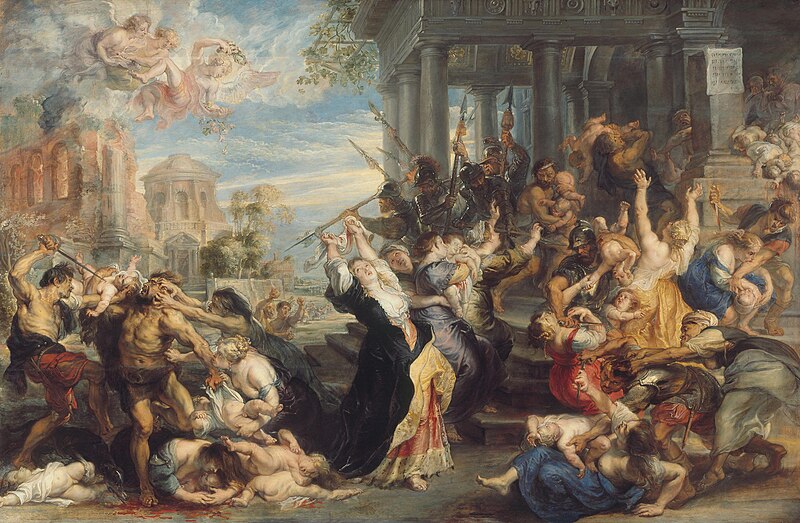
The massacre of the innocents is the part of the Christmas story every nativity play skips. What could be less suitable for kids? A vicious tyrant, slaughtered toddlers and that image of the spectral wail issuing from Rachel’s tomb in Ramah – it’s less It’s a Wonderful Life and more The Nightmare after Christmas.
Even granting for the sake of argument that the event deserves commemoration, does it belong in the festive season? And shouldn’t it be placed after Epiphany anyway?
Nothing can make reflecting on the events we remember on the Innocents’ day (also known as Childermas) less macabre. But contemplating them reveals that the message of Christmas is far more robust than the saccharine version we might find more comfortable at this time of year.
In his account of the massacre, Matthew uses two Old Testament quotes to highlight for us its significance. By quoting from Hosea 11:1 (‘Out of Egypt I called my son’), Matthew interprets Jesus’ flight to Egypt and his return as a recapitulation of the Exodus. His longer quote from Jeremiah 31:15 harkens back to the Babylonian Exile – the original wailing coming from Rachel’s tomb had been for Jews taken in chains to Babylon.
The combined effect underlines the depth of darkness into which Jesus came and the pitiable state of God’s people at his coming. Like Pharaoh, a wicked foreign King jealously guards his own position by ordering the slaughter of Israelite boys. Though they are back in their promised land, the brutal tyranny which oppresses them means they are as far from the home Rachel hoped for her children as they have ever been.
Herod, like many a tyrant, was a man of deep cruelty and wild caprice. He was gripped by fear of being usurped and had three of his own sons put to death in order to deny them the opportunity. He was as good an example as anyone who had ruled in Israel of the wretchedness to which fallen humanity descends when God is cast aside and nothing but the idolatrous lust for power guides the course of human affairs. It was into this man’s clutches that Israel had fallen in the days when Jesus was born.
But, and this is key to the story, Herod fears the infant born in Bethlehem. Rightly so. Jesus has come as the true King, and the overthrow of the tyrannical pretender is the logical outcome of his claim to kingship. Herod’s murderous response to the news of Jesus’ birth shines a spotlight on the depths of human evil which he has come to abolish. The futility of his attempt to nip Jesus’ reign in the bud speaks of his doom. As Jeremiah goes on to say, God hears Rachel’s weeping and will restore her children (Jer 31:16-17).
Since Jesus’ day there has been no end to tyranny. Alas, our world continually bears witness to atrocities which make the massacre of the innocents look relatively trivial. Even in the catalogue of Herod’s crimes, it was far down enough on the list that only Matthew reports it to us. But for all it’s disgusting depravity, the fear and futility of Herod’s response is a sign for any and all tyrants from his birth until the present day. The true King has come. They are all living on borrowed time.
Heavenly Father,
whose children suffered at the hands of Herod,
though they had done no wrong:
by the suffering of your Son
and by the innocence of our lives
frustrate all evil designs
and establish your reign of justice and peace;
through Jesus Christ your Son our Lord,
who is alive and reigns with you,
in the unity of the Holy Spirit,
one God, now and for ever.
This post’s image is Paul Peter Rubens’ The Massacre of the Innocents (ca. 1638) and is in the public domain.

 Christ and Calendar