According to all knowing Wikipedia, Dry January, an initiative which encourages people to give up alcohol for the whole month, is celebrating its 10th year in 2023 (presumably with a glass of orange juice).
Dry January comes in for a lot of stick from a certain kind of person. It, and its younger cousin Veganuary, are sometimes decried as a kind of latter day Puritanism. Much though it’s not how I would choose to get my Epiphany festive spirit going, I’m not actually opposed to Dry January. For many, it’s functioning as a kind of secular penitential season, and I observe those, just at different times.* Besides, alcohol abuse does ruin lives, and if it stops Christmas over-indulgence (which for many lasts the whole of December) developing into a serious drink problem, I’m all for it.
For Epiphany II, however, I want to reflect on a moment when Jesus’ glory was revealed in a way not in keeping with the spirit of dry January. As we see in the BCP’s assigned readings, it’s traditional at this time of year to remember Jesus turning water into wine at the wedding at Cana. “This, the first of his signs, Jesus did at Cana in Galilee, and manifested his glory. And his disciples believed in him.” (John 2:11) The wedding at Cana is an Epiphany moment.
But what kind of glory does Jesus manifest in Cana?
At the most obvious level, this story reveals the abundant joy of knowing Jesus’ glory.
Wine, properly enjoyed, is a delight to the senses. Held up to the light, its colours range from deep, purply reds, through vibrant cherry colours and soft rose pinks to pale greens, summer straw yellows and deep, golden ambers. Held to the nose, the bouquet can conjure almost any combination of fragrant smells, vanilla, summer berries, a subtle woodiness, melons, peaches, citrus. On the palate, it can be sweet, sharp, rich, silky smooth, gently astringent, lightly sparkling. Even in an appropriate moderation, it can induce, under the right circumstances, a relaxation, an almost giddy merriment like nothing else we routinely eat or drink. Sinful though drunkenness may be, wine itself is a glorious gift, given by God to gladden the human heart (Ps 104:14-15).
And this wine is a truly magnificent gift. Those who were present at the time, even after having drunk the place dry, are able to recognise that this is wine of the highest quality (v10). Though it’s easy to skip over this as we read, Jesus provides a lot of wine in performing this sign. At the church where I serve there is a stained glass window depicting the wedding at Cana. Like so many artistic depictions of this miracle, Jesus is making what look like six medium-small carafes of wine.
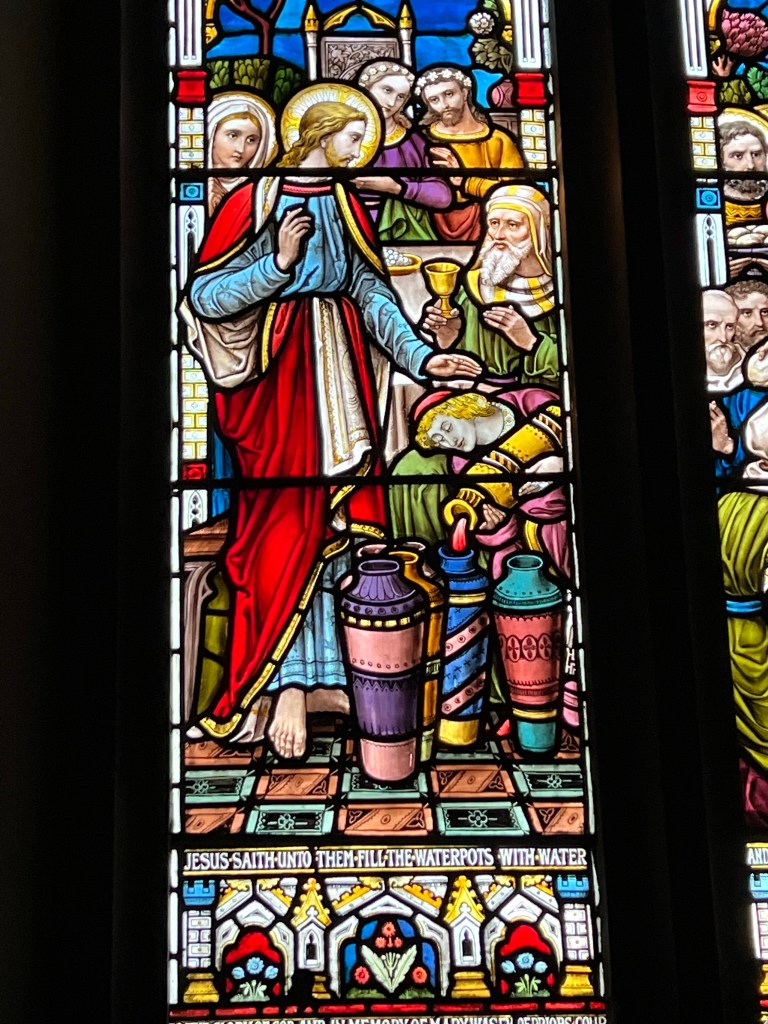
Admittedly, John is a little imprecise with his measurements. The jars hold ‘two or three metrētas’, a fifty percent margin of error. But taking that into account Jesus is making at least 420 litres of wine and possibly as much as 630 litres. That’s between 560 and 840 bottles of wine!
This sign, then, reveals that Jesus’ glory is to be our delight. All the pleasures of wine are meant as an echo of the pleasure to be found in grasping, or rather being grasped by, Jesus’ glorious grace, his endless kindness, his spotless purity, his ineffable wisdom, his faithful love, his magnificent courage. These are not qualities we are meant to merely admire from a distance – Jesus invites us to ‘taste and see that the Lord is good’ (Psalm 34:8).
It’s so easy, as C. S. Lewis once observed, to write about things beyond your own experience. I’m inspired in this area by my teenage contact with the spiritual vision of John Piper’s Desiring God. I’m not a big fan of the term ‘Christian hedonism’ but I think we see here something of the concept. In Jesus, we find an endlessly abundant source of joy and wonder, a true satisfaction for our souls, a pleasure surpassing the delight of wine. And he invites us to enjoy him.
I’m also inspired by the delight of Augustine’s relationship with God in the Confessions. In his prayer, we see something of that dizzying, intoxicating love for God. This passage, where he reflects on his conversion in sensual terms, came to mind:
You called and cried out loud and shattered my deafness. You were radiant and resplendent, you put to flight my blindness. You were fragrant, and I drew in breath and now pant after you. You touched me, and I am set on fire to attain the peace which is yours.
Augustine, Confessions X.xxvii (38), Henry Chadwick translation
This sign also taps into a much wider matrix of Biblical symbolism connected to the New Creation. Isaiah, for example, prophesies a day when
The Lord of hosts will make for all peoples
A feast of rich food, a feast of well-aged wine,
Of rich food full of marrow, of aged wine well defined
Isaiah 25:6
Likewise Joel prophecies: ‘in that day the mountains shall drop sweet wine’ (Joel 3:18a). The New Creation atmosphere is only enhanced by the context of a wedding feast – tapping into Scripture’s nuptial imagery.
Jesus is revealing here, then, that his glory is not only a source of joy and satisfaction to individuals. It is the centrepiece of a whole world devoted to the pleasure of his love, an eternity of besotted, giddy revelry in his magnificence.
There is a last facet to Jesus’ glory revealed in this scene. The jars used for this sign are used for ‘the Jewish rites of purification’ (v6). Their use is for removing the ritual uncleanness, constantly incurred in daily life. They testify to the constant unworthiness of fallen humanity to come into the presence of God.
Jesus’ transforming the water of purification in the wine of New Creation is a sign of what he does in and for us. Water will be a sign of cleansing and rebirth in the next chapter (3:5).** Jesus’ glory transforms not only the creation, but each of us, creating in us the eternal life that finds its full fruition in the glorified life of the resurrection.
And we get a tiny hint of how Jesus is able to do that in verse 4. All this revelation of New Creation glory is a bit premature. As Jesus says, his ‘hour’ has not yet come. Throughout John, ‘the hour’ is a reference to the cross, the place where, more than anywhere, John sees Jesus’ glory revealed.
The cycle of readings that usually accompanies Common Worship is not nearly so tightly tied to the collects as the BCP equivalent is. But the collect for Epiphany II still resonates with John 2 on several levels:
Almighty God,
in Christ you make all things new:
transform the poverty of our nature
by the riches of your grace,
and in the renewal of our lives make known your heavenly glory;
through Jesus Christ your Son our Lord,
who is alive and reigns with you,
in the unity of the Holy Spirit,
one God, now and for ever.
*If we’re being pedantic and giving the real life Puritans full credit, there is in fact nothing less puritanical than observing a penitential season. The whole calendar was something the Puritans were opposed to and they didn’t like Lent any more than they liked Christmas.
**A quick read through the rest of chapters 2-4 reveals that John brings up the themes of new life, bridegrooms, husbands, and existential thirst several times.

 Christ and Calendar