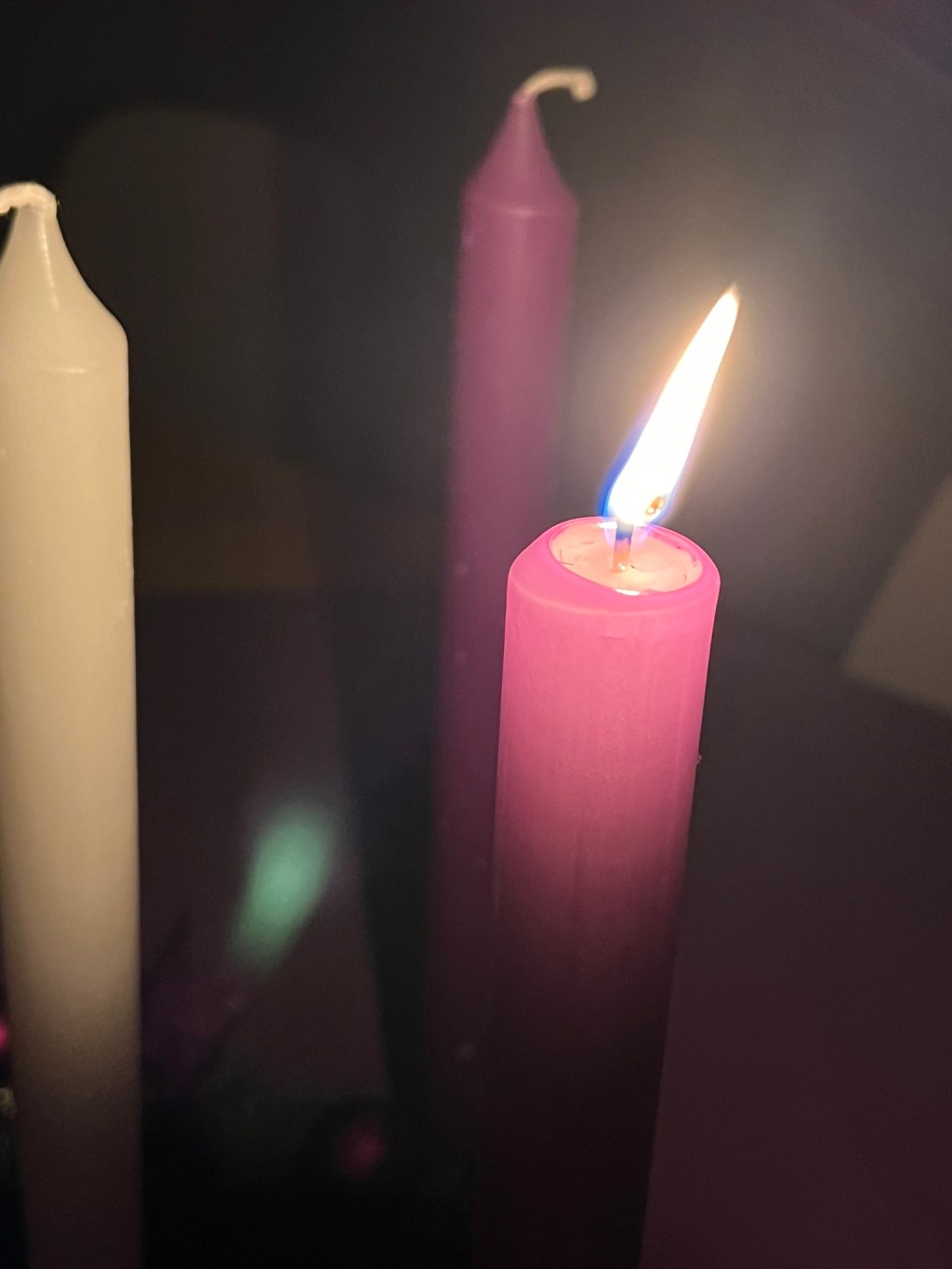
It’s very commonly said that Martin Luther loved Christmas. There’s even an urban legend that he invented the Christmas tree. So it’s fitting that many of our most beloved traditions for Advent and Christmas find their origins in German Lutheranism. The Advent Wreath is no exception and while it’s a relatively recent tradition, it’s become quite well established across denominations.
If you’ve never used one before, the wreath has four candles around the rim, one corresponding to each Sunday in Advent, and one at the centre, corresponding to Christmas. Each week a new candle is lit – we do ours at Sunday dinner – and there’s a moment for reflection and prayer. Because it’s relatively new, the symbolism attached to each of the candles is not nailed down and you’ll find a number of different schemes out there. The one we use runs Patriarchs – Prophets – John the Baptist – Blessed Virgin Mary – Christ. We like this one because:
- it takes us through the forerunners of Christ, who prepared for his first coming. That helps us to prepare for Christmas as we see it in its wider Biblical context and as I hope we’ll see, it has a lot to teach us about our own Advent hopes and expectations as we prepare for Christ’s return.
- it keeps our attention on the concrete events of redemptive history rather than devolving into abstractions.
- it fits well with the lectionary, which means that it dovetails nicely with the Advent collects which are the centrepiece of our Advent reflections. The Church of England has a set of prayers for this scheme (we usually use series 1), though I can never quite make up my mind whether I like them. You can look at them for yourself here.
I love the symbolism of having dinner in the faint light of a single candle at this time of year, with the light growing brighter and brighter as our reflections turn to figures closer and closer to Christ. I gave a brief reflection on how this scheme relates to the BCP collects last year but will be offering reflections on each of the candles for this year’s Advent series.

The Patriarchs and the Shape of Biblical Hope
In week one we remember the patriarchs. Usually, when I hear people talk about ‘the patriarchs’ I think of Abraham, Isaac and Jacob, the ancestors of Israel, but some churches also include David as Jesus’ ancestor and the founder of the dynasty. What these figures all have in common, in addition to being Jesus’ direct ancestors, is that they were recipients of promises and covenants which shape the Biblical hope.
In week one I focus on Abraham, because the Biblical hope is shaped around God’s promises to Abraham. Though the promises made to him are reiterated several times in the book of Genesis, I find Jonty Rhodes’ “People, Paradise, Presence” a helpful summary of the heart of the Abrahamic covenant.[1]
The promise of people takes the form of a promise that Abraham’s descendants will be a great nation. Up until Abraham’s day, there seem to have been a few people in every generation, who know the Lord – an Abel, or an Enoch or a Noah here and there. Now God makes clear he is going to bring about a world in which millions of people know him – in one passage he promises as many the stars of the sky or the sand of the seashore. No longer will knowing God be the business of a few scattered individuals. It will happen for whole communities, a vast family, a great nation.
And that community will have a home to live in, revealed in the promise of the land. Ever since the first humans were kicked out of the Garden of Eden, human sin has led to human scattering. Adam and Eve are exiled from paradise, Cain is exiled for killing Abel, the people are scattered after the tower of Babel. Now God’s people are being given a home. And that home is to be a paradise for them; in later Scripture it’s frequently likened to the garden of Eden, a land flowing with milk and honey. Abraham’s descendants will be God’s people living in paradise.
But best of all, God promises his presence with them. In Genesis 12, God is clearly watching over Abraham, blessing those who bless him and cursing those who curse him. As these promises are repeated you get expressions like ‘I will be God to you and your offspring’, ‘I will be with you’ ‘You will be my people and I will be your God’. God will be there with them, to bless them, to rule and guide them, to teach them, to protect them, to love them, to reveal the beauty of his glory among them. They will belong to him and he will belong to them.
The only thing I would add is the promise at the end of verse 3: “all peoples on earth will be blessed through you”. Abraham isn’t chosen just to receive blessings, but to be a blessing in the midst of the nations. God’s choice of Abraham isn’t about excluding the nations, but determining how he is going to reach the nations. In his letter to the Galatian churches, Paul goes so far as to call this “the Gospel announced in advance” (Gal 3:8). Through Abraham’s offspring, people, paradise, presence is to spread to every nation on earth.
These promises form the backbone of the Biblical hope.[2] As we prepare for Christmas, taking some time to reflect on Abraham helps us grasp the shape and scale of what Jesus’ birth means for the world. Jesus came to redeem a people from every tribe, tongue, people and nation, beginning with the Jewish people and spreading to every corner of the globe. His reign, as we will have opportunity to remember next week, will transform the whole creation into a paradise. His coming brings God’s presence among us and leads to the sending of the Spirit within us. United to Christ by the spirit we and all the New Creation will be maximally filled with God’s glorious presence. No wonder Abraham rejoiced to see his day! (John 8:56)
The Patriarchs and Living in Hope
Reflecting on Abraham not only helps us prepare for Christmas. It also has valuable things to teach us about the nature of hope, which are still just as applicable as we await Christ’s return.
Firstly, it should lead us to reflect critically on what we hope for. Obviously, we all have all kinds of hopes in life. Some are silly, trivial things. I hope the San Francisco 49ers beat the Philadelphia Eagles in the NFL on Sunday – though I definitely haven’t set my heart on it. But there are hopes that really speak to us deep down as well, aren’t there? Relationships we may long for; hopes for our children and grandchildren; things we hope to achieve that mean something; a standard of living we aspire to, perhaps.
None of those hopes are necessarily wrong in themselves. But if we let those sorts of things be our big hope, the thing that all our other hopes hang on, the thing we organise our lives around, the thing we think we could never be happy without, they will inevitably go wrong on us. Partly because those sorts of hopes often prove a letdown when we achieve them or else lead us to despair if our hopes are dashed. But mostly because as hopes they are just far too small. Anything less than hoping for God’s people, sharing paradise, enjoying God’s presence, reaching every nation is less hopeful than God calls us to be. In God’s promises to Abraham are hopes that surpass all that we can desire, with a security nobody can steal.
So Abraham should prompt us to ask what we really desire and hope for? Do we need to set our sights higher? Or is there something about People-Paradise-Presence that we find off putting? Why might that be and how can we discipline our desires to better fit what God has promised?
Abraham shows us what it looks like to live in hope. He left his country and his father’s house behind. Any hope that he may have entertained back in Ur of the Chaldeans he gave up on. A whole life that he had back there was abandoned, to go somewhere he’d never been before. When he left, he didn’t even know exactly where he was going. He just knew that God had promised a people, a paradise and his presence. And he knew that was better than anything he was leaving behind in Ur. But his neighbours, who didn’t have his hope, must’ve thought he was crazy, mustn’t they? To throw away the comfort and security of home for some pie-in-the-sky dream God had promised him.
Of course, Abraham’s life involved all sorts of secondary hopes. We know he was quite wealthy and played an active part in the communities he lived among. But those hopes and concerns were very much secondary to the hopes he had in God’s promise. At every major turning point in his life, these promises were the deciding factor in how he chose to act. It became so much his identity that he changed his name to Abraham – which means Father of a multitude – before he and Sarah had had a single child. He also crucially models for us the element of delayed gratification that is central to hope. Scripture repeatedly highlights that Abraham died still waiting for the promise to be fulfilled.
Abraham’s life should prompt us to ask ourselves whether we also live in hope. How are our ‘secondary’ hopes aligned to the great hope of God’s people enjoying his paradise in his presence? Do we ever have to defer, curtail or even abandon our secondary hopes because we are too engaged in pursuing our great hope? What risks are we willing to take because our hope is secure in heaven, waiting to be revealed (1 Peter 1:3-4)?
May the God of Abraham, Isaac and Jacob teach us to live in hope!
[1] See Jonty Rhodes (the Presbyterian minister, not the 90s cricketer!) Raiding the Lost Ark which I think is also available with the title Covenants Made Simple. Whatever you call it, it’s probably my favourite introductory book on covenant theology, even if I’m not quite convinced by his argument that this all necessitates presbyterian church government(!) Jonty would be the first to admit (indeed, he does in the footnotes) that he’s hardly the first to use a scheme like this (in Anglican circles, Vaughan Roberts has done something very similar in God’s Big Picture) but I find Jonty’s way of putting it best.
[2] I’ve chosen to focus on Abraham here, but if you wanted to see this in the Davidic covenant, you see it beat for beat in passages like 2 Samuel 7 or Psalm 72.


