He’s making a list.
He’s checking it twice.
He’s gonna find out
Who’s naughty or nice.
Santa Claus is coming to town!
Somehow, I managed to get to yesterday before I heard that song this year. But it felt fitting as I was already turning this post over in my head. My wife and I haven’t, thus far, been able to have children and, thank heavens, I’ve never been asked about him at a school assembly. So I’ve never had to decide what to tell a child about Santa Claus. But I know Christian parents have to decide and several that I know have found themselves conflicted.
I’ve never road tested this approach, but the way we’d handle it if we could comes out of the liturgical calendar. I want to say up front that this is one of those questions of conscience where I wouldn’t want to claim this is the only right approach. Indeed, my wife is a big fan of J.R.R. Tolkien’s Letters from Father Christmas, which he wrote each year to his children as they grew up, presumably because he took the exact opposite approach to the one I’d adopt.1
So there’s no judgement here, but there are some things I don’t love about Santa Claus.
Ethically, I share, to a point, many Christian parents’ concerns about deliberately trying to convince their children to believe a falsehood. It’s not that I’m always against make-believe – it definitely has a place in the healthy development of children. Nor do I think it’s especially likely that a well catechised child will suddenly question everything once they work out Mum and Dad were fibbing about Santa. The kinds of pressures a child’s faith will have to withstand at secondary school mean they need to reach late childhood with better reasons to believe than ‘Mum and Dad said’ anyway. But I still can’t shake the uncomfortable feeling that convincing your child to believe in an omniscient, benevolent, gift giving, invisible being who doesn’t exist is, well, lying.
Theologically, I’m concerned that Santa appears to work by a kind of inverse Gospel logic. Santa rewards the good and punishes (or at least leaves out) the bad. Glen Scrivener has done a better job than I ever could of explaining why that’s an issue in this poem: enjoy!
Socially, in a connected point, Santa observes our class and social divisions. I’m uncomfortable with the fact that Santa talks the talk of “each according to their merits”, but walks the walk of “each according to their parents’ means”. I had a solidly middle class upbringing and solidly middle class desires as a child and never worried whether Santa and his elves would have the funds in the bank to make good on my requests. But at Boys’ Brigade, my first taste of church, I knew children who couldn’t count on that. Whether your politics are more right wing or left, teaching children to understand those inequalities through the lens of their own naughty or nice behaviour seems highly unjust.
Devotionally, Santa is just too good. Maybe this shows an insecure lack of faith on my part. But I remember how magical I found Father Christmas as a little boy growing up in a fairly ordinary agnostic household. How impossible it was to get to sleep on Christmas Eve because my brother and I were just so excited. How we would wake up in the night and creep to the landing to see if our mince pie and carrot offerings had been accepted. The silent thrill of joy and wonder to find the empty pie dish and carrot end and to see, through the dim light of the landing window, our stockings filled to the brim with sweets and presents. I treasure those memories and (with hindsight) the evident joy my parents took in creating them. But Jesus was very much not the hero of my childhood Christmases. Don’t get me wrong: I definitely think Jesus is more exciting than Father Christmas and that it’s possible for a child to grasp that. But if I had children, much though I fondly remember the wonder of Father Christmas, I’d want to be really sure that the wonder they felt at Christmas was about God becoming a baby.
Culturally, perhaps I’m just being grumpy and/or nostalgic, but I kind of feel that as a child I grew up with Father Christmas, a jovial incarnation of some sort of deeply buried pre-Christian Yuletide. Santa Claus, by contrast, always seemed a more commercialised equivalent, the mascot from a Coca Cola advertising campaign. As the latter seems to have more or less squeezed out the former in popular culture, I can’t help but think that the tradition I loved as a child has already been replaced by a much less magical disneyfied alternative. But that very much might just be me.
So, all in all, I’m not the biggest fan of Santa. But I also don’t want to be a Scrooge. Saying ‘Bah Humbug!’ to Santa Claus is more likely to come across as being opposed to joviality and gift giving – two things I’m very much in favour of – than to communicate your passion for truth and the Gospel of Grace.
But the calendar offers an alternative which I think avoids these pitfalls – St Nicholas’ Day, which is celebrated today, the 6th of December.
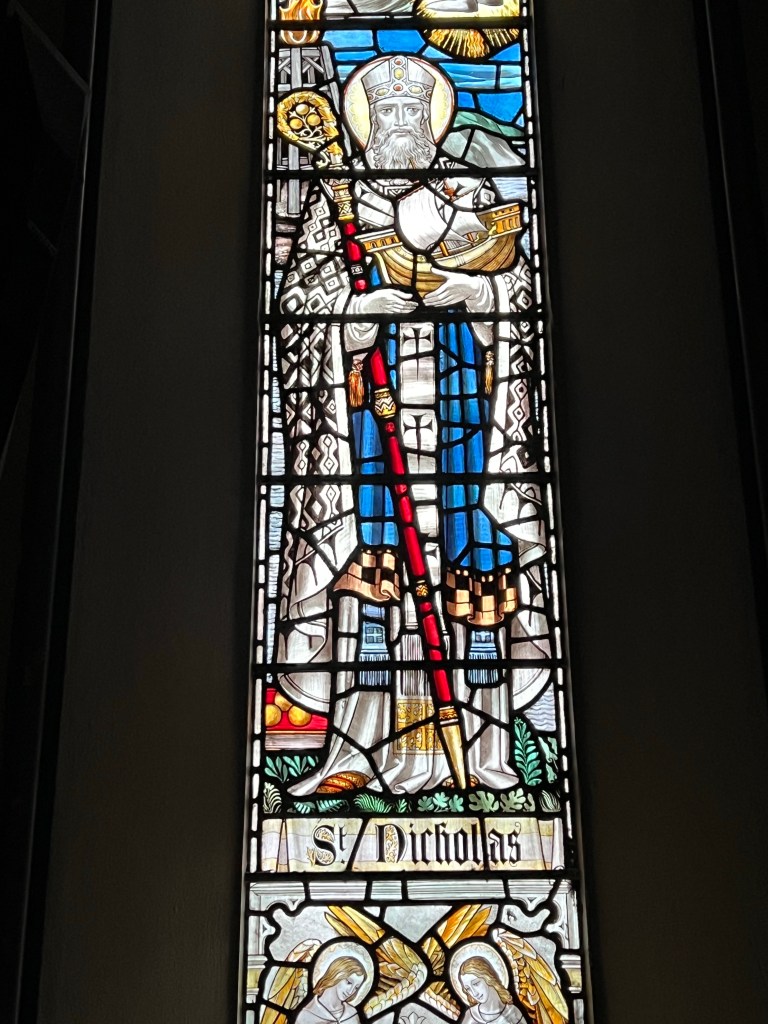
St Nicholas’ Day isn’t really a thing in the UK, but across continental Europe (including my Mother-in-Law’s home country of Poland) it’s much more widely observed. It’s quite common in several countries for children to receive a small gift and it’s the day when the equivalent traditions to leaving out your stockings for Father Christmas take place.
To my mind, there are lots of advantages to this.
St Nicholas’ Day commemorates a real historical figure, the fourth century Bishop of Myra. While it’s probably not true that he became so enraged when he heard the heretic Arius expound his views that he slapped him, thus nearly getting himself deposed as a bishop, it is likely that he attended the council of Nicaea. He doesn’t make it into any contemporary discussion of the council, so his contributions probably weren’t dramatic. But in some small way he contributed to preserving for us the truths about Jesus’ identity we’ll be celebrating at Christmas. So St Nicholas is genuinely Christmassy!
Theologically, as with any saint’s day, we do not venerate and certainly don’t invoke the saint in question. But we do give thanks for God’s grace to them in life and the way God used them as ministers of his grace to others. We strengthen our own faith and look to be imitators of their good example.2 The Gospel logic of keeping grace at the centre is preserved.
Like many saints in the early church, we don’t know too much of substance about his life, but he’s remembered as a champion of the vulnerable. The main legend that has grown up around him (apart from that one about punching Arius) involves him secretly donating a dowry for three impoverished women by dropping moneybags through their window, thus preventing them from being forced into prostitution. Another popular story has him bringing three children who had been murdered back to life. Clearly, I do not believe these stories actually happened, so I wouldn’t emphasise them if we had children, but I would say that Nicholas was a kind and godly bishop who was particularly remembered for his care to vulnerable people.
Devotionally, Jesus remains the hero even on 6th December. St Nicholas has his moment – Father Christmas imagery doesn’t have to be completely rejected and nobody needs to be a Scrooge about it. But by shifting it to 6th December, all things Santa related are well out of the way by 25th December, leaving Christmas exclusively for Christ.
So what do we do?
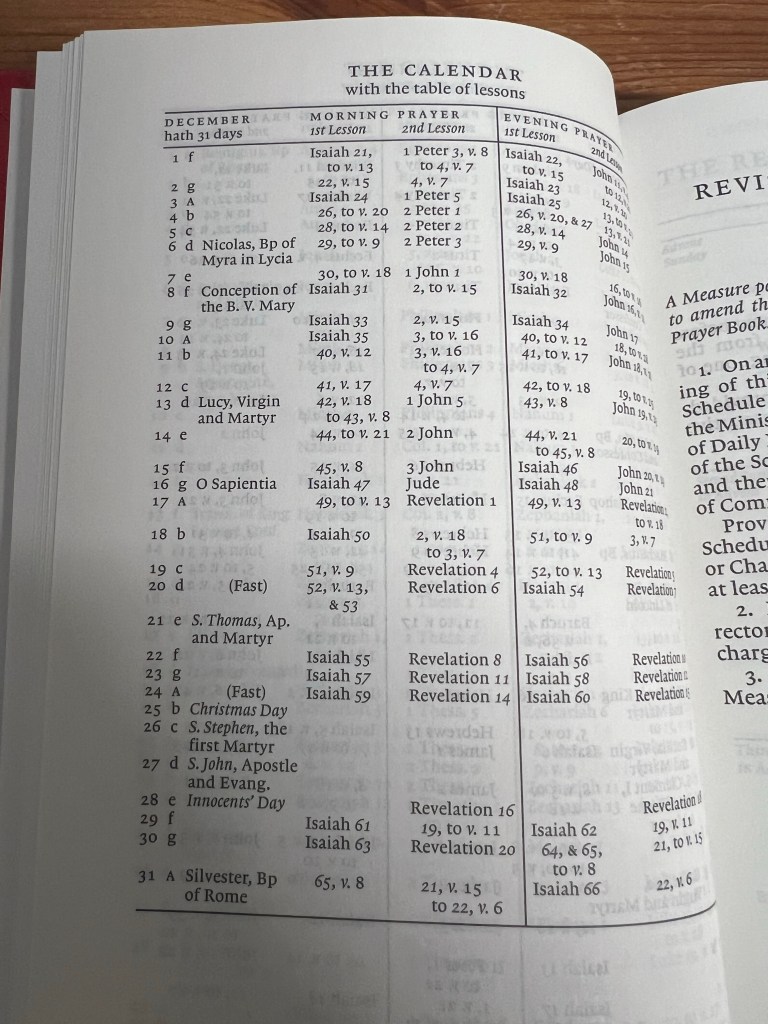
Well, the first answer would be not too much! These days, the ‘Common Worship’ suite of liturgical resources that the Church of England mostly uses does include a collect for St Nicholas’ day. It’s fine as far as it goes. If you really wanted to, there are suggested readings and everything. But my wife and I stick to the Book of Common Prayer which, wisely in my view, only provides liturgy and readings for saints who are in the Bible, and only a small number of them to boot. For people like St Nicholas, the BCP lectionary notes that 6th December is the day he is remembered and then carries on with reading the Scriptures sequentially. We have a bit of time for open prayer when we pray, and maybe one of us will give thanks for a particular saint whose day it is if their example has particularly stirred us, but generally these ‘black letter days’, so called because they are not highlighted in red as being a big deal, look no different to every other day as far as our family worship goes.
Outside of our family worship, the main St Nicholas day tradition we have is that during the night on the 5th, we try to sneak some small gift and some chocolate money (a reference to that dowry story I mentioned) into one another’s shoes. We both know perfectly well that they other person is going to do it, but the fun is trying to find a way to do it without them noticing. Putting it in your shoes is how they do it in much of Germany and some parts of Poland. If we had children, I wouldn’t pretend that these gifts came from St Nicholas (though many families on the continent do), I’d say it’s a game we play to remember and celebrate his generosity and his desire not to let his left hand know what his right hand was doing.

All this could simply conform to the secular pattern of December as a month of Christmas related over consumption, moving the Santa tradition away from Christmas but basically observing it as everyone else does. Since St Nicholas is remembered as a champion of vulnerable women and children, we try to donate to a charity that works with vulnerable people as a way of honouring his memory, and making sure that it’s not just about us engaging in self indulgence. If you’re not sure what to donate to and are a Christian who lives in the UK, thirtyone:eight almost certainly provide safeguarding help to a ministry that is dear to your heart. Why not consider donating here? I don’t know if there is a patron saint of safeguarding, but there are worse options than St Nicholas.
So that’s what we do and my entirely non-road tested approach to Santa Claus. I hope you find it helpful, but please don’t think I would judge you if you come to different conclusions. We all have to navigate these issues with our own contexts and the particular temperaments and needs of individual children. What matters above all is making a thought through, principled decision.
- The only reason I don’t count myself a fan is that I haven’t got round to reading them. I’ve never read anything by Tolkien that I didn’t love. The audiobook is even read by Derek Jacobi, who I imagine has an amazing Father Christmas voice. ↩︎
- For the Church of England’s official view on venerating the saints, see Article XXII of the Articles of Religion. For a brief and helpful hint at how Protestants should honour the saints, see the Lutheran confessional document Apology of the Augsburg Confession Article XXI, Paras 4-7 ↩︎

 Christ and Calendar