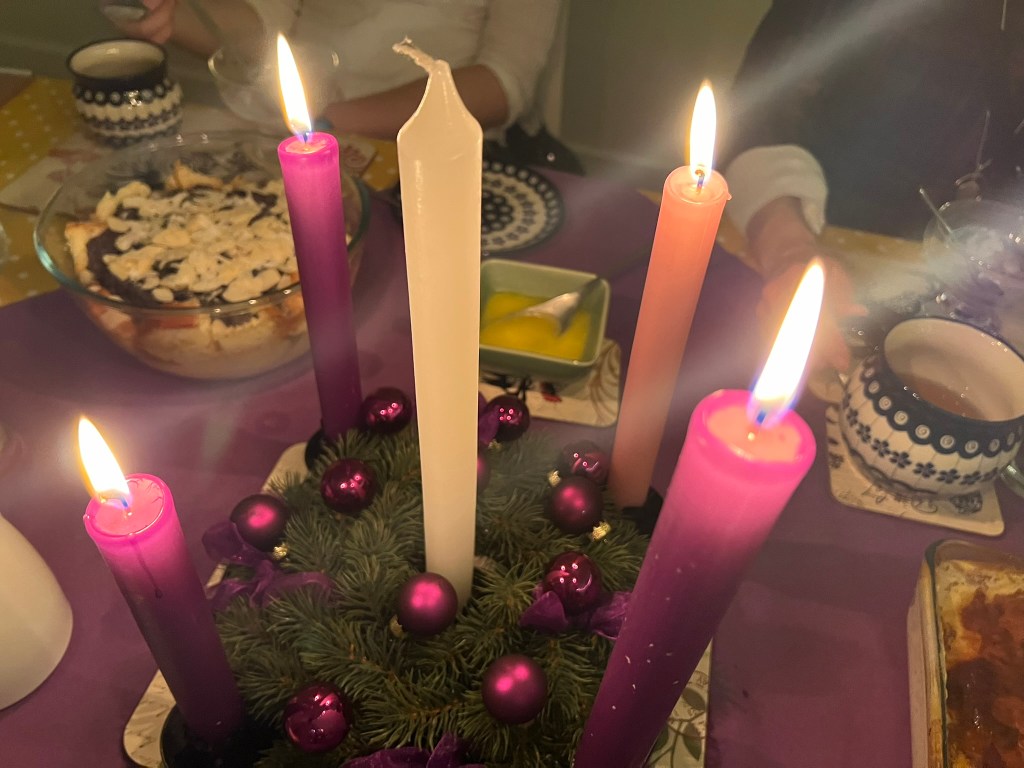
As it happens, Advent IV was eighteen months to the day since my wife and I first moved to Newbury.1 It’s amazing to think that a whole year and a half has passed already. I think 18 months is a decent amount of time to get to know a place. It’s long enough to get used to the way things are done here, to find out about all Newbury’s little quirks and foibles, and to find a few favourite places to enjoy at the weekend. In general, we’re extremely happy to be here and so grateful to God for the day that the parish profile was first passed on to us. Newbury has proven a really lovely place to live.
But… but there are just a couple of things about Newbury which, if we’re honest, we still find a bit odd. For one, it’s truly remarkable how many roads here have house names instead of house numbers. What’s that all about? How is anyone who’s new to this place supposed to find and address like that? Honestly, I’m just relieved I came here to be a curate and not a postman, it must be an absolute nightmare!
But the other thing that is a bit strange about Newbury is how half the churches here are St Mary’s. If I were to jump in the car right now, in just a few minutes I could be at St Mary’s Speen, or St Mary’s Thatcham, or St Mary’s Greenham, or St Mary’s Shaw cum Donnington, or St Mary’s Upper Bucklebury and I gather there was once a St Mary’s Speenhamland too. And half of them are even neighbouring parishes! I actually did a baptism earlier this year where part way through the service someone realised that they’d meant to be at the service for a child getting baptised down the road.
All of which is to say that it’s obvious that the churches round here were built at a time when Mary was really very popular indeed! In fact, she must be one of the most celebrated people ever to have lived. And whether you’re listening to Schubert’s sublime musical setting of the Ave Maria, at the National Gallery looking at Sassoferrato’s beautiful painting of the Virgin Mary at prayer, or in Rome contemplating Michaelangelo’s sculptural masterpiece, the Pieta, it’s undeniable that for centuries Mary has inspired some of the greatest works of art in Western culture.
Over the last few weeks, we’ve been looking at some of the figures who acted as forerunners of the coming of Jesus. We’ve looked at Abraham and God’s promises to the Patriarchs. We’ve thought about the prophets and their offer of salvation. We’ve looked at John the Baptist, sent to prepare the way of the Lord. Today we are thinking about Mary. But I want us to be careful to look at the real Mary, the Mary we meet in the Bible.
Coming to a Biblically balanced view of Mary can be tricky for us today.
On the one hand some people have claimed some extraordinary things about Mary – that she never sinned, that she’s the Queen of Heaven, the Bride of the Holy Spirit, our mother in heaven and co-redeemer of the world. But on the other hand, some people, partly as a reaction to the exaggerated emphasis that is placed on her, have downplayed Mary so much that they get a bit uncomfortable talking much about her at all.
I can’t address everything the Bible says about Mary in one post2, but we’re going to look at three things in particular that come out of the Scripture passages we’ve just been hearing.3 We’re going to see that Mary is blessed, Mary points us to Jesus and Mary shows us how to be blessed.
Blessed are you among women…
So, first of all, Mary is blessed. If you were here with us last weekend for the carol service you will have heard the choir sing the carol The Angel Gabriel with its refrain “Most Highly Favoured Lady”. I wonder how you feel when you hear Mary described in those terms. Is that not, maybe, going a bit far? Well, no, it isn’t. In our passage today Elizabeth says she’s blessed among women, which is an idiomatic way of saying that she’s the most blessed of women. Although, actually, she doesn’t say it, she exclaims it with a loud voice at the prompting of the Holy Spirit. Mary herself likewise prophesies that for the rest of time all generations will call her blessed. That’s why Mary is sometimes referred to as the Blessed Virgin Mary.
In fact, Luke chapter one uses no fewer than three different Greek words to try to articulate just how blessed Mary is. When the Angel Gabriel greets her in verse 28, he uses a word for ‘blessed’ that means ‘highly favoured’. In verse 42 Elizabeth uses a word for blessed that carries the sense of enjoying divine approval. In verse 45 she uses a different word for blessed that means ‘flourishing’ – Mary herself uses that one in verse 48. It’s as though the Greek language is bursting at the seams, straining to finds ways to express how richly blessed Mary is.
Because Mary has the astonishing privilege of being the mother of the Lord. That’s what Elizabeth calls her in verse 43. She is the mother of God – not that God’s divine nature comes from her, that would be absurd – but he received his human nature from her and Mary’s child was God incarnate. When the Word became flesh it was her body that gave him flesh. God incarnate has Mary’s nose, or perhaps the shape of her eyes, or the colour of her hair, because she gave him nose and eyes and hair in her womb. What an astonishing thought!
Mary fed and clothed and cared for God. She taught God – not only all the endless life skills our mothers teach us, but she shared her knowledge of the Scriptures he was to fulfil. She looked after God, soothed him when he was frightened and when he fell over and grazed his knee, it was Mary he instinctively ran to. What a calling!
And that’s just Jesus’ childhood. Mary also got to be there for almost all of the key moments in Jesus’ life. She saw his first miracle in Cana and his last breath on the cross. She was probably one of the women who first saw the risen Jesus4 and she was there in the upper room on the day of Pentecost. Luke tells us more than once how she treasured things up in her heart and pondered them. Just think of all the things she must have seen and heard living with God incarnate for thirty years. What a privilege!
I’m not sure how many people here would worry about this, but just in case, let me reassure you that there’s absolutely nothing unProtestant, as it were, about acknowledging how blessed Mary was. All the original reformers did. John Calvin, in his commentary on this passage, wrote “to this day, the blessedness brought to us by Christ cannot be the subject of our praise, without reminding us, at the same time, of the distinguished honour which God was pleased to bestow on Mary, in making her the mother of his Only Begotten Son.” That’s certainly true here, when you think about it. As a church that uses the ancient creeds every week, Mary is one of the few people who gets a mention at every service here. Rather like in the Gospels, she’s not front and centre, and if you’re not paying attention you might not even notice she’s there. But it’s impossible to tell the Biblical story of Jesus without mentioning Mary at some point.
Looking at the history of Christianity, two things tend to happen when people try to downplay how blessed Mary is. The first is that bad things happen to your understanding of the incarnation. It pushes people to conclude that either Mary’s child is somehow less than fully God or else somehow less than fully human. If Mary isn’t the mother of God, then either her child isn’t really God or she isn’t really his mother. Either way, the key thing we celebrate at Christmas, the Word becoming flesh, is lost. And if that’s lost, everything is lost.
The other thing that happens if you downplay the role of Mary is that you’re likely to downplay the role of women in the Bible more generally. If Mary, the most blessed woman who has ever lived, is a marginal figure for you, surely all the other women are, if anything, even more marginal. If Mary was “just” Jesus mother, but all the really important stuff was done by Peter, James, John, Paul and the other apostles, it’s hard to avoid the conclusion that motherhood – something many women give years of their lives to, something which shapes almost every human being at the most formative time in their lives – is really not that important a vocation. Recognising Mary’s blessedness is the first step to recognising and honouring God’s work in and through other women as well.
…and blessed is the fruit of your womb!
So, like Elizabeth, rejoice with Mary. But please don’t stop there! That would be a travesty! The biblical Mary always, always points us to Jesus. So recognise and rejoice in God’s favour showed to Mary, but use it to lead you to rejoice in his favour shown in Christ.
That, after all, is what Elizabeth does. In the same Spirit inspired exclamation, she goes straight from “blessed are you among women” to “blessed is the fruit of your womb!” Mary’s blessedness only makes sense in the light of Jesus.
That might sound obvious, but it’s a thought with deep, deep Biblical roots. In our reading from Genesis this morning, we see that the ancient enmity between the woman and the serpent leads to an endless battle between her offspring and the serpent’s. The woman’s offspring looks to crush his head, the serpent’s offspring looks to bite his heel. Only in Jesus does the woman’s offspring find a final victory. Jesus’ death looked like a decisive victory for the serpent – killing off God’s Messiah. But it was actually the final defeat of the devil. As the serpent delivers his most venomous bite, the son crushes his head forever. Jesus is the offspring of Eve who will bring God’s final judgement against the serpent.
That’s why Mary’s song begins by glorifying the Lord and rejoicing in God her saviour. She isn’t the hero of her story and she isn’t the hero of her song. Her saviour is. Her song of joy, what’s commonly called the Magnificat, isn’t about everything she’s going to do, it’s about everything the saviour God is going to do through her Son. He is the one whose Kingdom will humble the proud, topple the oppressor, and bring justice to the poor and hungry. He is the one who will bring about all that God promised to Abraham.
So by all means rejoice with Mary, but rejoice with Mary in her saviour. This is why, in the Church of England, we don’t pray to Mary or the saints in any of our authorised liturgies. Instead we put our hope where they put their hope – in Jesus. A virgin mother is a mighty miracle from God – you can sort of understand why, of all the miracles in the Bible, it’s probably the one that has attracted the most scepticism from the world. But it’s nothing compared to the Word made flesh. By all means marvel at what God did in and through Mary, but follow through to the wonder of the incarnate son, our saviour.
Blessed is she who believed…
As you do that, the last thing you can learn from Mary today is how to be blessed. One of the problems with putting Mary on a pedestal, as though she were some kind of super-saint who is completely beyond us is that we lose Mary our sister. Because when you look carefully at what the Scriptures say, Mary’s path to blessing is the same as ours.
Again, it’s Elizabeth who says it for us in verse 45. Blessed is she who has believed that the Lord would fulfil his promises to her. Mary is blessed because when the Angel Gabriel told her something she knew was impossible by nature was about to happen for her, she put her trust in God and accepted that his promise would be fulfilled. So she said to the Gabriel “May your word to me be fulfilled”.
Jesus himself gives us another angle on this later on in Luke chapter 11. To be honest, the NIV is translated in quite an unhelpful way here, but in chapter 11 verse 27 a woman says to Jesus “blessed is the womb that bore you and the breasts at which you nursed”. Jesus replies ‘Blessed rather are those who hear the word of God and obey it’. Now I think the NIV is a bit embarrassed about talking about Mary’s body in that way so it goes for ‘blessed is the mother who gave you birth you and nursed you’5 but I promise you that isn’t what it says in the Greek and it’s not how lots of other translations put it.
Jesus isn’t trying to deny that his mother is blessed – we’ve already seen that she’s more blessed than any woman whose ever lived. But she’s blessed because she heard the word of God and obeyed it. Again, what did she say to the Angel? Not “Get pregnant outside of wedlock? That sounds like it’ll carry some social stigma” Not “be the mother of someone who claims to be the true King of Kings? That could be dangerous!” Not “Be responsible for raising the Son of God, that sounds quite high stakes!” She said “I am the Lord’s servant. May your word to me be fulfilled.” It’s that heart of faith in God’s promise and obedience to his word that meant Mary was blessed even before the Angel Gabriel came to her. The word dwelt in her heart before he became flesh in her womb.
That same word of promise, that same call from God, is before us today. Sometimes it seems to promise impossible things – the free forgiveness of sins, the resurrection of the body, the life everlasting. Sometimes it asks hard and frightening things of us – take up your cross and follow me. We all know, don’t we, the temptation to doubt or to disobey. At other times in Scripture we see Mary facing that temptation too. But if we, like Mary, say “I am the Lord’s servant. May your word to me be fulfilled,” then we will be blessed with Mary6 and can rejoice with her saying ‘My soul glorifies the Lord and my spirit rejoices in God my saviour.” Amen
- This is a lightly adapted transcript of a sermon I preached that day. ↩︎
- For one thing, the more I reflect on Scripture, the more I find it saying about her. ↩︎
- Genesis 3:1-20, Luke 1:39-56. ↩︎
- There’s some dispute about this, but many commentators identify her as “Mary the mother of James and Joseph” in Matt 27:56,61, 28:1. c.f. Matt 13:55. ↩︎
- I genuinely don’t think there is a conspiracy to downplay Mary at work here, but it’s the effect of this translation choice. If, as I imagine, it is at least partly motivated by an embarrassment of talking about Mary’s breasts and womb, it seems a good example of unwittingly downplaying both the goodness of women’s bodies and the realities of Jesus’ experience of infancy. ↩︎
- There was no space for this in the sermon, but one more observation on this point. The participle used of Mary in 1:28, translated ‘favoured one’ in the ESV, has historically been used to say that Mary has a special status; she is ‘full of grace’. It’s a rare verb in the New Testament, and it only appears in one other place: Ephesians 1:6 tells us that God has blessed us in the Beloved. In Christ, Mary’s blessedness is given, with every spiritual blessing in the heavenly places. ↩︎


