In 1891 (says Google) the German botanist Reinhard Knuth noticed something interesting about a flower he was studying. Parts of its petals reflected ultraviolet light. Human eyes, of course, cannot see ultraviolet but many pollinating insects can. And as botanists have looked into this more, they’ve found that a great many flowers are actually covered with UV patterns invisible to the naked eye which serve to attract insects and guide them towards the centre of the flower.
I find this fact enchanting because humanity has always found flowers beautiful enough just as they appear to our eyes. For millennia we have been painting them, writing poems about them, celebrating festivals for them, growing them in our gardens, giving them to our loved ones – they delight us! But all long there has been a riot of colour and patterns on display that none of us will ever truly see, that most of us do not know is there. A whole world of hidden beauty lies beyond our powers of perception.
Michaelmas falls at a time when we in England are surrounded by the colours of autumn leaves rather than the blossom of spring, but I thought of this yesterday as I reflected on the feast of St Michael and all angels. I don’t believe I have ever seen an angel, or even any concrete evidence for their existence, though in the Bible, people do sometimes interact with angels without knowing it. But I believe in angels because they are everywhere in the Bible and Jesus commends the Bible to me as God’s word written. And angels really are everywhere in the Bible. There are loads of them in Genesis and loads of them in Revelation. They turn up at Christmas, and they are on the scene at Easter. They feature in historical narratives, and the visions of the prophets. You meet them in the close theological reasoning of Paul’s letters, and the poetic praises of the psalter. They are all over the place in that most baffling of Biblical genres, apocalyptic. From start to finish, the Bible is saturated with references to an entire society, a whole world, of which few mortal eyes have ever caught more than a glimpse.
Maybe this is just me, but I think that angels are a subject that is easy to neglect both because they are too everyday and because they are too weird. As a Bible reader, I’m constantly reading about angels doing this, that or the other, but I wonder whether they are so common in the Bible that I sort of mentally gloss over them. On the other hand, I imagine that most of my secular friends, neighbours and relatives would think my belief in angels superstitious and irrational. Even amongst other Christians, I hardly ever have a conversation in which angels feature as a reality of daily life, rather than just a detail of the Biblical text.

But angels do have a recognised place in Western culture. I was in Pret the other week when I noticed this poster. Like all the others, it conveys a message by whimsically arranging sandwich ingredients to make a picture. But it stood out to me because in an otherwise completely secular setting, it used a religious image. I don’t want to overread this, but it seemed as though all the other messages talking about things like nutrition, sustainability, recipe development, price, responsible sourcing and so on fitted easily within the default secularism of British middle-class life. But this one is paired with an angel. It’s as though, deep down, we all know that we could only imagine a thought so spectacularly optimistic as “kindness is never wasted” (notice the emphasis on never) to be true in a world where there is an unseen order and things like angels watching over us. The statement “kindness is never wasted” is just like the statement “God’s angels are at work among us”. Either it is a matter-of-fact statement about the way things are, or it is a superstitious and sentimental piece of make-believe.
The Prayer Book Collect for Michaelmas highlights three things about the angels:
O everlasting God, who hast ordained and constituted the services of Angels and men in a wonderful order: Mercifully grant that, as thy holy Angels alway do thee service in heaven, so by thy appointment they may succour and defend us on earth; through Jesus Christ our Lord. Amen.
Order
Firstly, the address reminds us that God has arranged the angels and humankind in a “wonderful order.” We really are given only the most fleeting glimpses into this, but the Bible seems to reveal that there are different kinds of angels. We meet Seraphim (Isaiah 6), Cherubim (Ezek 10), Watchers and Holy Ones (Daniel 4), Thrones, dominions, rulers, authorities (Col 1, c.f. 1 Peter 3:22), at least one angel, Michael, is an Archangel. It’s never elaborated in detail (both Christian and Jewish tradition have had several goes at filling in the gaps) but it’s clear that there is some kind of order or hierarchy among the angels. They certainly fulfil a range of functions. Some are messengers (in both Hebrew and Greek, the word for angel literally means ‘messenger’), others are warriors (the expression translated (somewhat blandly) ‘Lord Almighty’ in the NIV or (somewhat archaicly) ‘Lord of Hosts’ in the ESV refers to the armies of God’s angels), clearly some of them are rulers of some kind in the spiritual realm, others seem to spend their whole time in worship, like the four living creatures in Revelation.
As I’ve been writing this, one question I have wrestled with is “what if God hadn’t made the angels? What would we be missing out on?” Presumably, God could fulfil all the functions angels currently serve – revealing and fighting, ruling and enjoying his glory – himself. He does not need the angels any more than he needs us. But the universe would be less wonderful. What we would be missing was thousands upon thousands of lives. Glorious lives, each revealing God’s power, wisdom and love. Diverse lives, each revealing God’s glory in a different way. Mysterious lives, each a testimony to the fact that even in this creation, let alone in God, there are wonderful things beyond our mortal ken. The Bible’s testimony to the angelic realm should increase our wonder at the universe and the order in which God has arranged it.
Worship
The request highlights that the angels constantly serve God in Heaven. So far as we can tell from Scripture, the devil and his angels (another topic for another time) fell at some point prior to the fall of humanity, but those angels which did not rebel simply remained faithful. So the holy angels are all, apparently, sinless. We allude to this fact in the Lord’s Prayer when we ask that God’s will be done on Earth as it is in Heaven. In Heaven, God’s will is done perfectly by the angels and we ask that it might increasingly be so here on Earth.
The ‘service’ especially calls to mind the angels in worship, which was commonly called ‘divine service’ when the Prayer Book was composed. Certainly, for users of the Prayer Book, worship is going to be one of the contexts in which angels are most frequently mentioned. In certain psalms, for example, we actually address the angels, encouraging them to praise the Lord and looking to join in ourselves (see, e.g. Psalm 148, which also hints again at that “wonderful order” in the universe). We reference the worship of the angels in the opening words of the Te Deum, and express our hearty desire to join in! In the Benedicite, we address the angels in terms very similar to some Psalms. And at Holy Communion we join ‘with Angels and Archangels, and with all the company of heaven’ to praise God in the words of the Sanctus. The reality of angels reminds us that the purpose of the universe is the continual adoration of God.
Defence
The request itself, though, emphasises another theme in the Bible’s teaching about Angels. We ask that they will “succour (i.e. support) and defend us.” This comes up frequently in Scripture. Sometimes in quite general terms: “The angel of the Lord encamps around those who fear him, and delivers them.” (Psalm 34:7) “He will command his angels concerning you to guard you in all your ways.” (Psalm 91:11) “Are they not all ministering spirits sent out to serve for the sake of those who are to inherit salvation?” (Hebrews 1:14) Sometimes, it is hinted that something more specific may be going on. Angels seem to be assigned to individual nations (as in Daniel 10, though there some of the angels appear to be hostile), individual churches (as in the opening letters in Revelation, though other interpretations are possible) or even individual people (as in Matthew 18 or Acts 12).
Angels, then, have an important ministry in protecting us from harm. I can’t explain exactly how that works. But I have experienced things which seem to me to be a kind of spiritual attack. It is a comfort to know that there is also spiritual defence going on behind the scenes. As is so often the case, we have little idea how much we have to be grateful for. There isn’t much of this referenced in the Prayer Book, but if you say Compline, most Anglican services will include at least one or two prayers which allude to the protection of the angels.
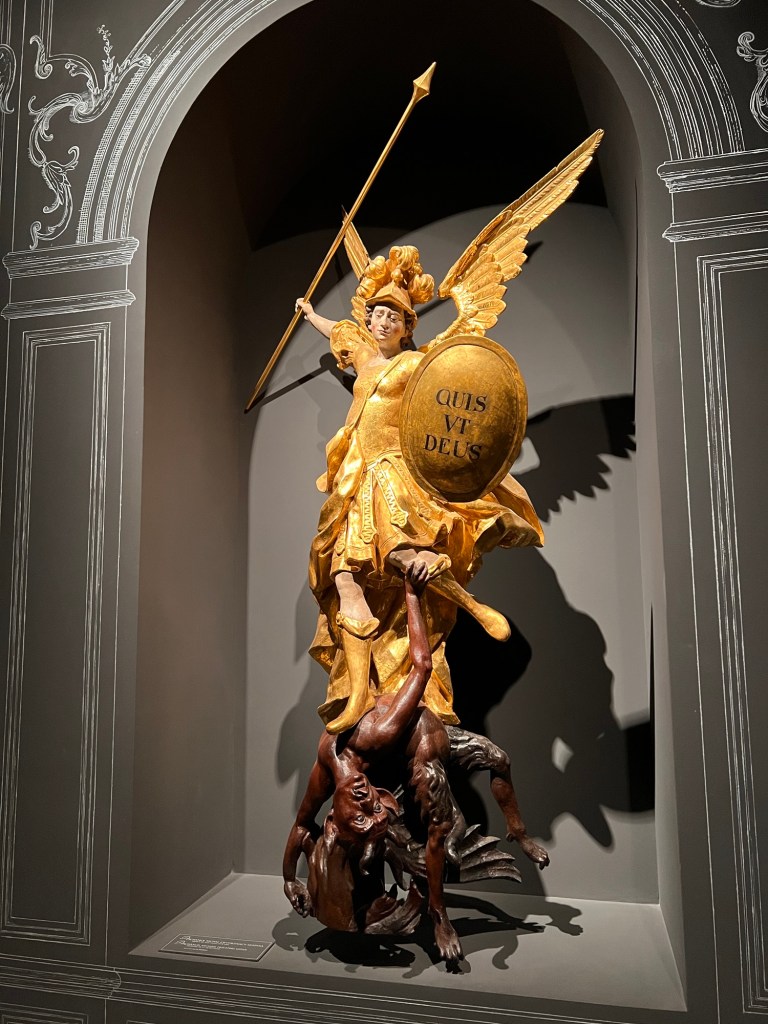
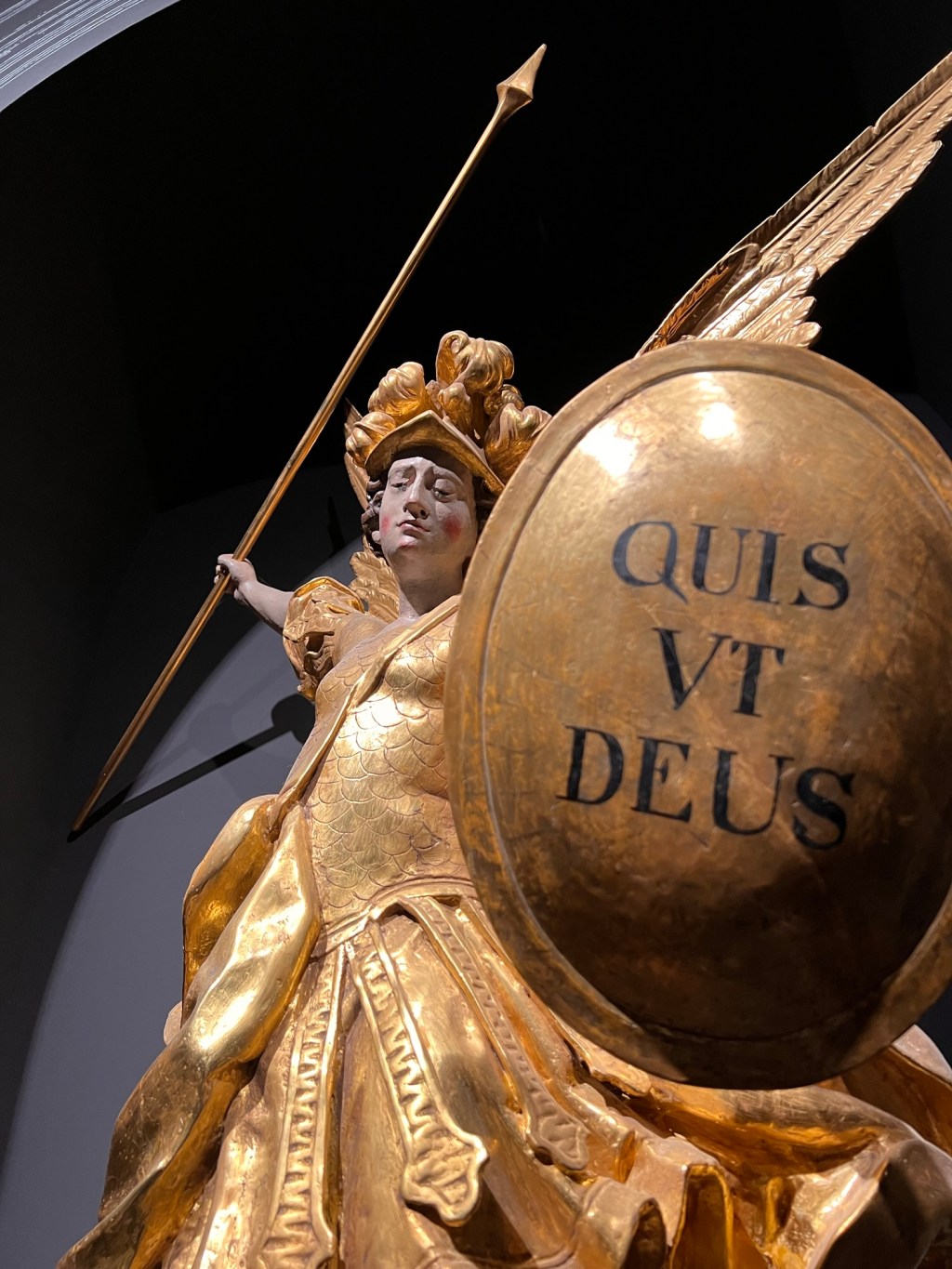
A last word about Michael the archangel. He’s not actually mentioned in the collect itself, but the day takes his name because he is the archangel in the Bible – no other Angel is called an archangel. He appears four times in Scripture, twice in Daniel, where he is clearly an angelic warrior who watches over Israel. He is mentioned again Jude, in an allusion to an extrabiblical story about a dispute he had with Satan over the body of Moses. But it is Revelation 12 which is chosen as the Holy Communion reading to accompany the collect. Here, Michael battles the devil and his angels and succeeds in casting them out of Heaven. It is a decisive, though not a final, defeat for the devil. He no longer has access to God’s throneroom in Heaven to slander and accuse God’s people (compare the opening of Job). Revelation is a notoriously difficult book to interpret, but Joel Beeke’s commentary suggests, with some plausibility for me, that this took place at the time of Jesus’ death and resurrection. (see Rev 12:10-11). Michaelmas reminds us that in the heavenly warfare, it is the angels of light who will prevail over the forces of darkness. But as in all things and as in our prayer, they will do so ‘through Jesus Christ our Lord.’ Amen.
The statue of the archangel Michael defeating Satan is found in the Wawel Castle in Kraków, Poland. I took the photos myself.


 Christ and Calendar